Fresno Fly Fishers For Conservation
Sixty Five Years and Counting...
| | Fly Dope Volume 65 Issue 01 | | | December 2025
A Note from the President: Reflecting on the Season and Preparing for the Next
As the mist settles over our favorite runs and the trout move into their winter lies, the quiet of the off-season offers us a rare moment of stillness. It is a time to look back on the memories made on the water this year—the successful drifts, the missed strikes, and the quiet camaraderie found along the banks. We feel greatly blessed to be part of the Fresno Fly Fishers for Conservation. What a year we've had!
Before we lean our rods against the wall for the winter (if you are not into winter fishing!), we owe it to ourselves (and our gear) to perform a final "end-of-season audit." Taking the time now to scrub the grit from our fly lines, patch those nagging wader leaks, and back off the drag on our reels isn't just about maintenance; it’s a ritual of respect for the sport. A little care today ensures that when the first hatches of spring arrive, we are ready to step back into the current without a hitch.
Beyond the gear, however, is the heartbeat of this community. On behalf of the board, I want to express our deepest gratitude for your participation this past year. Whether you volunteered for a stream clean up or a trail restoration project, helped mentor a young or mature caster during our academies, or simply shared your stories and valuable insight at our monthly meetings, you are the reason our mission thrives.
Your contributions to our conservation and education initiatives have a direct impact on the health of our local watersheds and the future of the sport we love. Because of your generosity and passion, we aren't just catching fish—we are ensuring that the generations following us will have cold, clean water and wild fish to pursue.
Thank you for being an essential part of this journey. We look forward to seeing you at our January Lower Kings outing, and even more, sharing another great year with our FFFC friends and family.
Tight lines and warm wishes,
CHRISTOPHER ROBBINS,
President FFFC
| Alaska on the Cheap
January 8th 7PM
Provost & Pritchard Office Building | | Join us for an informative presentation on how to plan a trip to fish Southwest Alaska on a budget. Club members Spencer Neville and Bill Bruce Fished in Alaska in August 2025 and have come home full of information they are happy to share. What time of year should you go? What equipment do you need? What techniques can you use to catch the fish of a lifetime? These questions and more will be answered.
Date: January 8, 2026 7PM
| | | | You also have the option to attend the meeting virtually via Zoom. Zoom information will be available as the meeting date gets closer. You will find the information within the general meeting announcement on the club's main page Here | Lower Kings River Cookout & Fishing Competition
January 17th
Avocado Lake
Our annual Lower Kings River Cookout is tentatively scheduled for Saturday January 17th. The Lower Kings River is a great winter fishery with the potential to catch rainbows in the 20" range. Just 30 minutes from Fresno, this makes for a great day trip! We'll fish the morning, gather for lunch at Avocado Lake to swap stories, then fish the afternoon. This is a great outing for all skill levels. If you are new to fly fishing or new to the Lower Kings River, there will be plenty of seasoned fishermen from the club to help you catch fish.
New this year - we will host a morning fishing contest with the winners recognized and trophies given at lunch (deadline is noon that day). There will be two prizes - one for the most fish and one for the largest fish netted. Proof will be by pictures taken of your fish caught that morning and verified by a panel of distinguished judges.
The club will provide hot dogs, hot links and all the fixings.... We ask that you either bring a side dish to share or make a $10 donation to support the club (don't let the money or side dish keep you from joining us). Also, please remember that there is a $5 entrance fee for Avocado Lake Park. And don't forget to bring a chair.
Please click the link below to register for the event so we know how many hot dogs and hot links to bring.
|
List of Events and Outings
January 8 Club Meeting - Presentation, "Alaska on the Cheap" Read More
January 17 Lower Kings River Cookout & Fishing Contest
February 28 - March 1 Lower Yuba River Outing
This is a unique opportunity to fish the University of California managed private waters on the Lower Yuba River below Englebright Dam. This scenic and challenging stretch of the river has a great reputation for strong active rainbows and steelhead. The event is currently sold out. Email Time Ritchey (our host) at tritchey@comcast.net if you are interested in adding your name to the waitlist.
Coming Soon !
Information coming soon regarding one of our premier events - our annual visit to the Upper Kings River (above Pine Flat). Look for more information, including a date, in the near future.
Go Here to see our full Event Calendar
Return to Table of Contents
| It's Winter - Let's Fish
It’s cold and foggy here in the Valley and you’re tired of not seeing the sun. The trout you fished for in the summer are still in the river and contrary to what you may have heard, fish do eat even in the dead of winter. Fish metabolism is tied to water temperature. When the water temperature drops fish become less active and less likely to move very far for a fly. In the winter, trout are probably going to be found in deeper holding water where they need to expend less energy. Because the bottom of the river creates friction for moving water the current will slow down and you will often find trout taking advantage of this. | | As you climb in elevation you will eventually find yourself above the inversion layer. The Kings River above Pine Flat is often right at that interface between fog and sunshine. With lower flows and the sun above, you have an advantage when it comes to finding trout in clear water. Sight fishing to trout with a nymph is on par to watching fish rise to a dry fly. As you will read in the article I have linked, small flies can be just the ticket this time of year – think LBS (little black sh*t). | | | Now, you may want to use a bigger heavier fly on point to get the smaller bugs in the zone.
There is another upside to winter fishing, sleeping in. Because even a slight bump in temperature can get the fish feeding, it makes sense to wait until mid-morning to start fishing. In the case of BWO’s (Baetis), they won’t start to hatch until usually after lunchtime. Yes, there are times when a dry fly can be very productive even when it’s cold out. The window for this particular hatch is narrow and may last only an hour or less and then it’s back to dredging the depths with nymphs.
If you don’t mind the often foggier and colder weather here in the Valley, it’s a much shorter drive to the Lower Kings near Avocado Lake. The fish are usually not wild but they are often plentiful and eager (if the poacher’s haven’t beat you to it). These fish are fresh from the hatchery and are caught using a variety of flies. You can catch them on black zebra midges but you don’t have to stick to the tiny stuff. Egg flies, mops, San Juan worms, and even streamers are effective. Come join us on our Outing January 17th on the Lower Kings River and find out how much fun fishing in winter can be.
| Beginner Fly Tying Class
Bob Scheidt | | Bob Scheidt is offering a beginner fly tying class beginning Saturday January 24th. This is a 7 week course From Jan 24th thru Mar 7th. The class is targeted for beginners to learn how to tie some basic fly patterns that you will fish in our local waters.
Class is limited to 6 attendees and will require a $10 registration fee to cover the cost of hooks and other materials.
| | | It is recommended that participants bring their own vises and tools.
The class is held at Bob's house in Fresno near Bullard and Millbrook. Please call Bob with any questions at 559.288.5276. He will provide you with his address after you sign up.
| Back of Beyond Stephen Neal
In Wildness is the Preservation of the World - “Henry David Thoreau."
Our Earth is a Symphony Made of Many Songs | The storm songs of autumn are promulgating the airwaves of the Pacific North West (PNW). The composers of these fall symphonies have chosen to highlight wind instruments in their musical masterpieces. The tumultuous music is strong, deep, and violent at times. The storm wind’s musical uproar induces the trees to dance, but these are not stately waltzes, for this is the music of Holst – The Planets. Specifically, the planet Uranus. “The Magician.” This music penetrates the heart of the forest, stripping away leaves, limbs, and branches, occasionally shattering trunks or even uprooting entire trees. Yet within that power is a gentle musical progression that renews, nourishes, and plants the seeds for new growth; it is music that transforms that which it touches.
Fortunately, the storm’s opening notes gave us time to batten down our hatches before the storm song reached its crescendo. We were able to enjoy the music and suffered little damage to our property from the big “W”(wind). (Fishermen are a superstitious lot; we just call it “W”! Kind of like witch and wizarding folk who speak of “he who shall not be named”.) Unfortunately, the rest of the region did not fare as well. The heavy wind music did heavy pruning on the PNW’s forested landscape. There were beauty and grace in the trees’ dancing, but fiber and sinew have breaking points, and many failed.
The wind and wind-caused detritus combined into a force capable of overwhelming the power grid’s weaknesses. Failures cascaded like dominos. Powerlines were cut, torn, and shredded. Moisture was forced into | | transformers. Electric current flashed, heat rose, and the system failed. A transformer substation lay in ruin. The Enumclaw Plateau and many other areas were hit, separating a large swath of electrical and cable customers from the grid.
Soon man-made notes joined nature’s orchestrated symphony. Gas powered emergency generators joined the winter storm song. They played nonstop for the next 33 hours. Ours kept our food cold, beds warm, and provided enough light to read by. The storm’s symphony continued throughout the night and into the morning. Man-made notes continued long after the storm’s passing.
In the neighbor’s pasture two elderly Big Leaf Maple trees were heavily pruned. They no longer appear like the party tree in front of Bilbo Baggins’s Hobbit house in the shire. These monarchs of the forest now lie broken and misshapen, their separated limbs and torn trunks stark reminders of their fateful last dance. Their total makeover by the computer has them fitting the seasonal Halloween theme. | 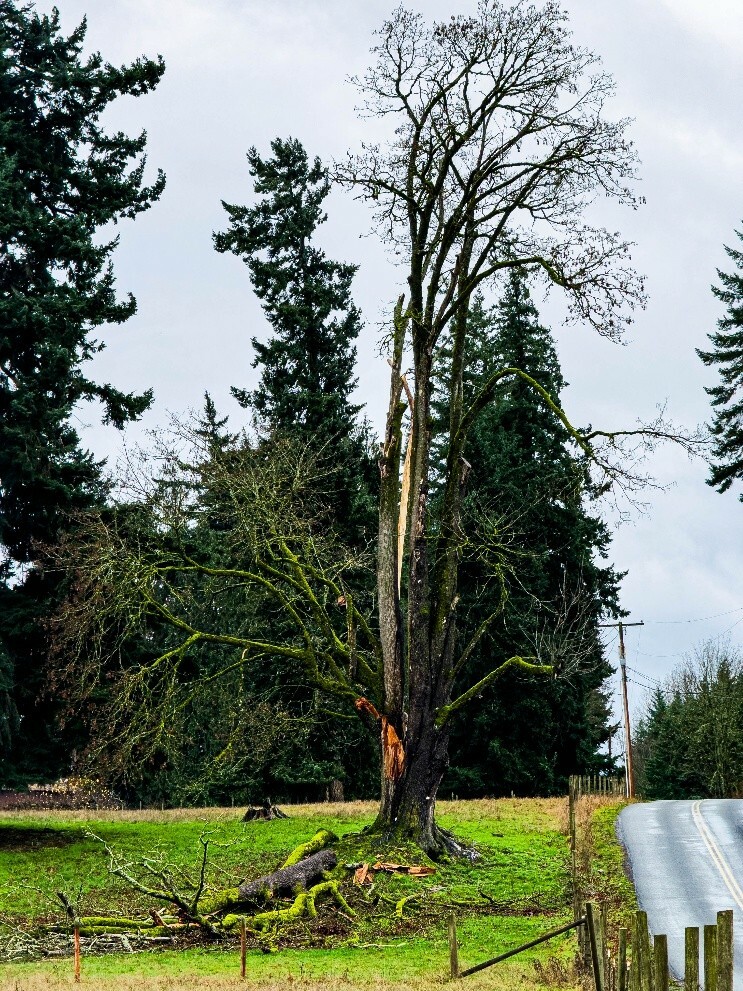 | | | 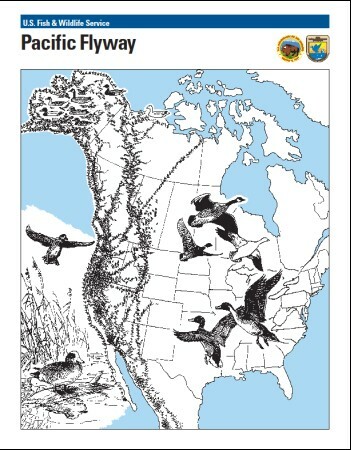 | | As the storm’s music played, a separate musical piece revealed itself, the song of birds. The storm’s music almost overpowered it, but it was there. The southward fall bird migration on the Pacific Flyway was at its height, its musical crescendo. Most noticeable was the music of Canada Geese attempting, in the teeth of the storm, to land in the dairy pastures across the road. Their music was a song of passage through turbulent weather and the quest to find feed, fuel and shelter, an oft repeated opera in all migrating bird species.
It is odd how an epiphany hits and stuns one as random pieces of information picked up over a lifetime snap together like a jigsaw puzzle, thus painting a picture one’s mind has never before perceived. Each recognized note now makes the music richer, more intimate, personal. Background noise that had been identified simply as honking geese takes on a whole new meaning. I began to “hear” the music, and my mind began to paint a more perfect picture of how big this song was. | | | As the storm’s music played, a separate musical piece revealed itself, the song of birds. The storm’s music almost overpowered it, but it was there. The southward fall bird migration on the Pacific Flyway was at its height, its musical crescendo. Most noticeable was the music of Canada Geese attempting, in the teeth of the storm, to land in the dairy pastures across the road. Their music was a song of passage through turbulent weather and the quest to find feed, fuel and shelter, an oft repeated opera in all migrating bird species.
It is odd how an epiphany hits and stuns one as random pieces of information picked up over a lifetime snap together like a jigsaw puzzle, thus painting a picture one’s mind has never before perceived. Each recognized note now makes the music richer, more intimate, personal. Background noise that had been identified simply as honking geese takes on a whole new meaning. I began to “hear” the music, and my mind began to paint a more perfect picture of how big this song was.
I could not see them, but I could picture them. They had come directly from their departure site, flying through this autumn storm of destructive wind and heavy rain. Even without specific visual cues they knew their location. When the sun shines, they rely on it and their internal circadian rhythm - a biological clock that allows them to interpret the sun’s position relative to the time of day, and they adjust their flight accordingly. With that and the visual cues of mountains, valleys, and rivers, they unerringly head for their preselected site. On relatively clear nights they read star patterns while accounting for the stars’ rotation around Polaris. But tonight, the storm precluded the use of those tools. Without any discernible effort they flew on, using their ability to read the earth’s magnetic field and their sense of smell to bring them safely here even in the storm. Now that they were here, I could hear them circle as their honking grew stronger, weaker, and then stronger again as they came in to land. Their circling allowed them to gather information from other geese and migratory birds that had preceded them. Was it safe? Was there feed? Could they rest up? With their questions satisfactorily answered they could land; if they received negative information they would head for a predetermined alternate stopover location.
This song was repeated all along the length of the Pacific Flyway from its northern reaches to the tip of South America and beyond. It is majestic music, 5,000 miles long and up to 1,000 miles wide. It encompasses 380 plus migratory bird species and over a billion birds from gram-sized Rufus Hummingbirds to Tundra Swans with six-foot wingspans. The flyway runs along the Pacific coast of North and South America. Some of its migratory birds fly as far south as Patagonia and as far north as Alaska, including the Aleutian Islands. The flyway is bounded by the Pacific Ocean to the west and the Rocky Mountains to the east. It is the second longest bird migration flyway in the world. Its terrain provides all needs for a billion plus birds to migrate twice annually. No matter where you step, sleep, drive, or look in the western United States you are in the Pacific Flyway, cohabitating with over a billion migratory birds.
Curiosity has filled my life with wonders. Now when I view migrating birds in their distinctive V formations I hear and see a song of connection, a joining of species, of landscape, of biology, of physics, of instinct, and of learning. All this creates a story of survival that has lasted for thousands of years. Each individual piece is filled with magical properties unseen that put our mega-computers to shame. With awe, I marvel at the innate intelligence of nature that guides life across this globe that floats in the heaven we call Earth.
In closing I challenge you to look up, to wonder, and to respect the genius of our natural world. Always stay curious. A simple musical note and an immense storm can open a world of wonder. Take time to listen to the music of life, our earth.
A Big Thank You, to Tennis Terrance for his editing suggestions.
“The world is out there, the journey starts the minute you leave the door, go outside and truly live.” – S. Neal
“When given the choice between being right or being kind, choose kind – Dr. Wayne W. Dyer
“Many go fishing all their lives, without knowing that it is not fish they are after” - Henry David Thoreau
| | Member Benefits and Additional Links |
|
California Fly Fisher Magazine discount benefit for our members!
|
|
Big News! A new benefit for our club members!
We are thrilled to cast this announcement your way - our club has netted a discount to California Fly Fisher magazine.
The magazine presents itself as California's only dedicated fly fishing publication. Some of our members subscribe to the magazine and praise the quality of the articles and writers as well as it's focus on California fisheries.
If you check it out and decide to subscribe, use code FLYCLUB to receive a $5 discount on a subscription.
|
|
Here's a link to the magazine:
|
|
|
Here are a few additional links to other information and websites you might find useful:
| OUR MISSION
We are a Fly Fishers International affiliated club, a national organization whose goal, like ours, is to promote the wonderful sport of fly-fishing as well as protect our natural resources. We promote catch and release, education, conservation, and above all, encourage and help those who desire to learn more about all aspects of fly-fishing.
Fly Fishers for Conservation (FFFC) was organized in 1961 by a group of devoted fly fishers deeply concerned with the preservation of trout and all game fish, their environment, and the quality of fishing. Our club has maintained two goals since that time: To foster and promote the sport of angling with artificial flies. To protect, conserve and increase our angling resources.
Go Here if you would like to join our club!
Fly Fishers for Conservation is a 501(c)3 tax-exempt non-profit organization. This means you can use your contribution as a tax deduction. The club gets revenue from member-ship dues and the annual fundraiser dinner. We try to contribute to conservation issues in the area and to our youth with our Trout in the Classroom program, the No Child Left Inside program and by holding a Youth Fly-Fishing Academy annually. The club is al-ways in need of funds. Please consider donating. You may send a check to Fly Fishers for Conservation at PO Box 1192, Clovis, CA 93613. Your donations will be greatly appreciated and they will help the club fulfill its obligations.
| | Guides and Businesses that Support the Goals and Mission of Our Club | |