Fresno Fly Fishers For Conservation
Sixty Five Years and Counting...
| | Fly Dope Volume 65 Issue 04 | | | Editor's Note:
Welcome to the April 2026 FFFC Newsletter!
Don't forget to reserve you seat at this year's Fly Fishing Film Tour event being held on April 2nd. There are only 80 seats available and we expect the event will sell out.
You'll need a ticket to be there to advantage of all of the great items available in the Silent Auction. Guided trips, new rods and reels, flies and more will be auctioned at the event.
Please Note:
Downloadable files of the newsletter will be available in our club's Document Library within a few days of the newsletter's release. Here is a link: Fly Dope Newsletters
Tight Lines!
Mark
|
While this saddens us as diehard anglers, we have plenty of water to explore. In addition to hiking the Kings this week, I escaped the heat by going up, up, and up--well into the mountains. The Sierra creeks hold beautiful trout, including rainbows, browns, and brooks. Whether I used a delicious black ant, a stunning royal wolf or even a perdigon dropper, the fish were eager. It requires some hiking and a willingness to approach a stream quietly, but beautiful trout await a patient and dedicated fly fisher.
So tie up those dry flies, strengthen those hiking legs, and get out and enjoy what our Central Sierras have to offer.
Tight Lines!
Christopher Robbins
President
| | April 2026
Most Excellent FFFC members.
As of this writing our mighty Kings River is flowing at 5,000 CFS. I have fished that river every week for the last six weeks and the water level was higher every time. Netting those amazing wild, freestone rainbows required every skill I've learned as a member of the Fresno Fly Fishers for Conservation.
Today, I ditched my rod and just hiked. I hiked well past Spring Creek and stood spellbound as I looked east where the river exits the gorge. El Rio de los Reyes is indeed the River of Kings! It's majestic, spectacular, gorgeous, rugged and beautiful. And we love it. But for a few months, it's basically unfishable.
| | | Special Event
Thursday April 2nd 7PM
Provost & Pritchard Office Building
| We're thrilled to sponsor the 20th anniversary of the FT3 film festival on April 2nd for our general meeting. We introduced the FT3 film festival last year to great success, featuring fly fishing from Patagonia to Oregon to Belize, and beyond. This year, for the 20th Anniversary of the Fly Fishing Film Tour (F3T), the "previews" promise an experience even more immersive than last year. We aren't just watching fishing; we are witnessing a global celebration of the heritage and conservation efforts that keep our sport alive.
Our curated selection for the April 2nd meeting will take us to the furthest reaches of the map:
-
The Untamed North: We’ll journey to the Yukon Territory in Yukon Resurrection, chasing the "Arctic Tarpon" (Inconnu) and massive Lake Trout in waters few humans ever see.
-
The High Desert of Patagonia: We’ll revisit the discovery of Jurassic Lake, where the world’s largest Rainbow Trout defy belief.
-
The Saltwater Frontier: We’ll feel the adrenaline of the Baja coast in the Rooster Fly Project, a film that balances heart-pounding "eats" with the vital science of protecting the iconic Roosterfish.
-
Conservation at Heart: Closer to home, Guardians of the Snake will remind us why we, as the Fresno Fly Fishers for Conservation, do what we do—highlighting the fight to protect the wild Steelhead and Trout of the Snake River.
From the "Freshwater Permit" (Pacu) of the Amazonian jungles to the healing waters of Montana, this year’s tour proves that fly fishing is no longer just a hobby—it is a powerful, visual testament to the wild places we love.
You'll need a ticket to be there to advantage of all of the great items available in the Silent Auction. Guided trips, new rods and reels, flies and more will be auctioned at the event.
Tickets are available here:
https://flyfilmtour.myeventscenter.com/event/Clovis-Ca-Fresno-Fly-Fishers-For-Conservation-122028/purchase | 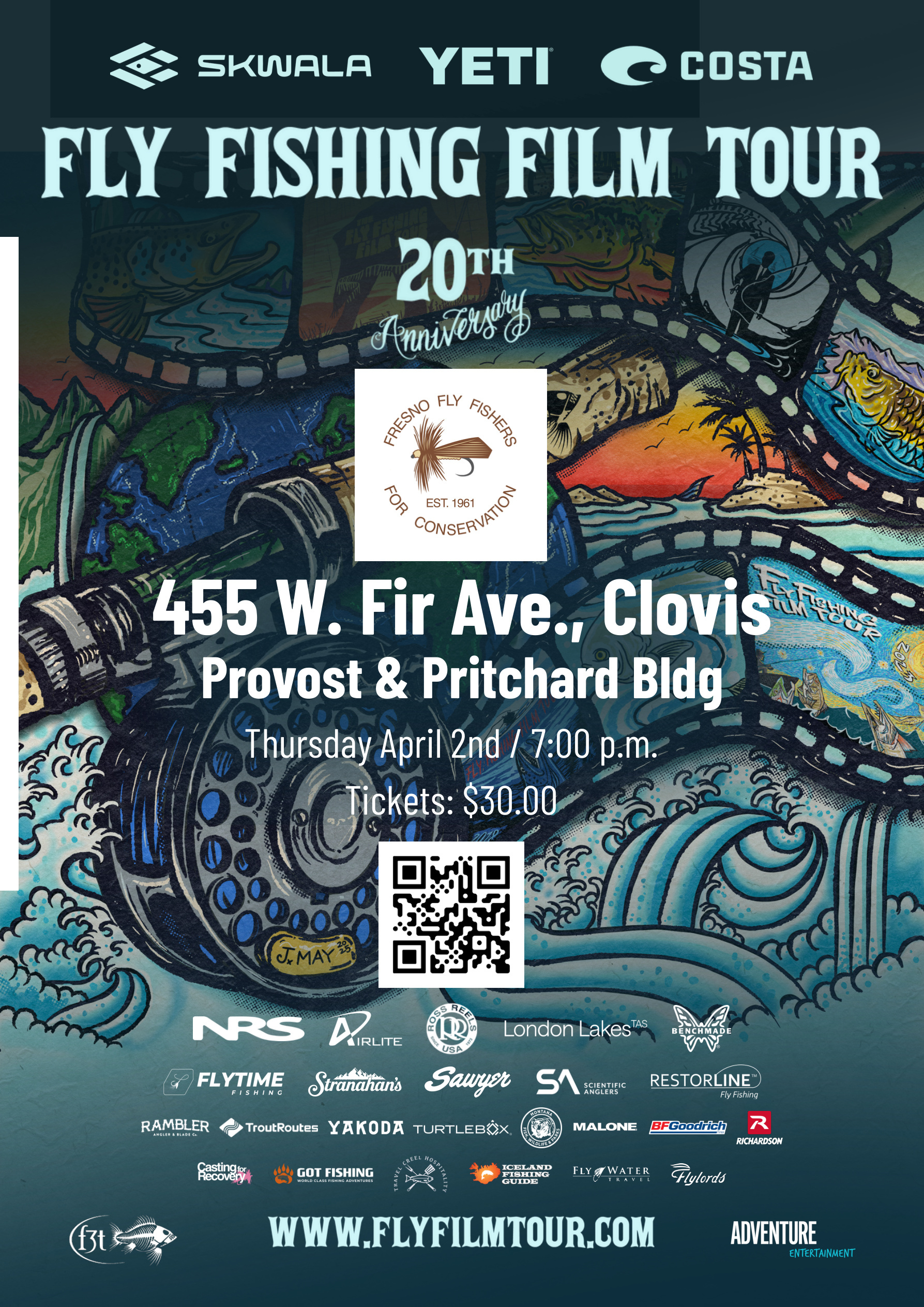 |
This month we are including an article that mentions our club and events from the early 1960's. Ed Schroeder is mentioned in addition to other members from our club during those early years.
Reprinted with the permission of Umpqua
Enjoy
| Umpqua has built an empire in our industry, and it started with an A Frame Cabin on the banks of the North Umpqua River. Based on all accounts, it should not have happened. It was such an improbable story you could have never come up with most of it. Doing things that no one had ever done before, and yet, it happened.
In the process, Umpqua changed the way the fly fishing industry was able to scale and grow through the production and delivery of fly tackle and the highest quality flies, designed by Royalty Tyers. Umpqua is built on a legacy of innovation and has encouraged innovation at pivotal moments.
This is the Umpqua Story told by some of the people who were witness to the events. | Soulful Beginnings - the early 60’s | | While life on the east coast in the early 60’s was marked with political turmoil around the JFK assignation and MLK delivering his powerful I Have a Dream speech, life in Fresno, California was simpler. Anglers were getting together, sharing ideas, and chasing trout. Dennis Black, Umpqua’s founder, was gifted a fly rod and then a fly tying kit by his family shortly after moving to Clovis, CA from Compton. This changed his life and the lives of many others that he would come in contact with throughout his life. | Dennis Black (left) and Carlos Urtabae (right) | Dennis connected with The Flyfishers for Conservation club in Fresno and the Buz Buszek bunch. This was an eclectic and influential group of tyer-anglers that were advancing tying and angling techniques on a monthly basis. They had weekly outings to nearby Sierra waters and to Oregon. Dennis became part this core inner circle, which included Dave Inks and Ed Schroeder, and formed key relationships and learned to tie and fish from the likes of Buz Buszek, Darwin Atkins, Ira Lingren and Doug Prince. He became a fanatic and was soon tying commercially.
“Since the moment I met Dennis, my destiny was tied to him. Back in 1964 I went to a Fresno Fly Club meeting and bumped into Dennis. We got a bite to eat together afterwards – and from that point on we were fishing together once a week if not more!”, an excerpt taken from an interview with Ed Schroeder, Umpqua Signature Tyer and early sales rep. | John Tarintino, World Champion Fly Caster 1965 | Dennis met Randall Kaufmann and Jack Dennis at Jackson Hole in 1966 when they were tying flies in the Rod and Reel shop and Dennis was attending the second annual Federation of Fly Fishers (FFF) conclave. This was a fortuitous meeting and the three became lifelong friends, collaborators and business associates.
During a 1968 club outing to Davis Lake, Oregon, Dave Inks took Dennis to the Umpqua to meet Frank Moore, legendary steelhead angler and proprietor of Steamboat Inn. They hung out together and according to Dave, “By the next weekend Dennis was moving to Winchester along the banks of the North Umpqua, where he started Black’s Custom Flies in a carport addition.” | Ted, "The Englishman" tight to a steelhead in the ledges pool on the North Umpqua River in 1969's Oregon | Doug Prince, creator of the Prince Nymph on the Kings River in 1963 | The business name, Umpqua Feather Merchants, began in 1969 when Dave Inks purchased 10,000 Chinese necks from a feather merchant in Fresno, shipped them to Dennis in Oregon and for a while they were in the wholesale feather business.
Randall Kaufmann had joined Dennis in Roseburg at the tying bench in 1969 and both were tying 12-15+ dozen flies each day by 1pm, filling orders for 500 dozen flies a month.
Ed Schroder remembers visiting his friends on the Umpqua river, “These guys (Dennis and Randall) were robot tyers. They raced each other. No one tied better flies, faster. They started at 5:30am, cranked out 12 dozen by noon, then they might go steelhead fishing, but always return to the shop to fill material and custom fly orders. And they did that 7 days a week!” | 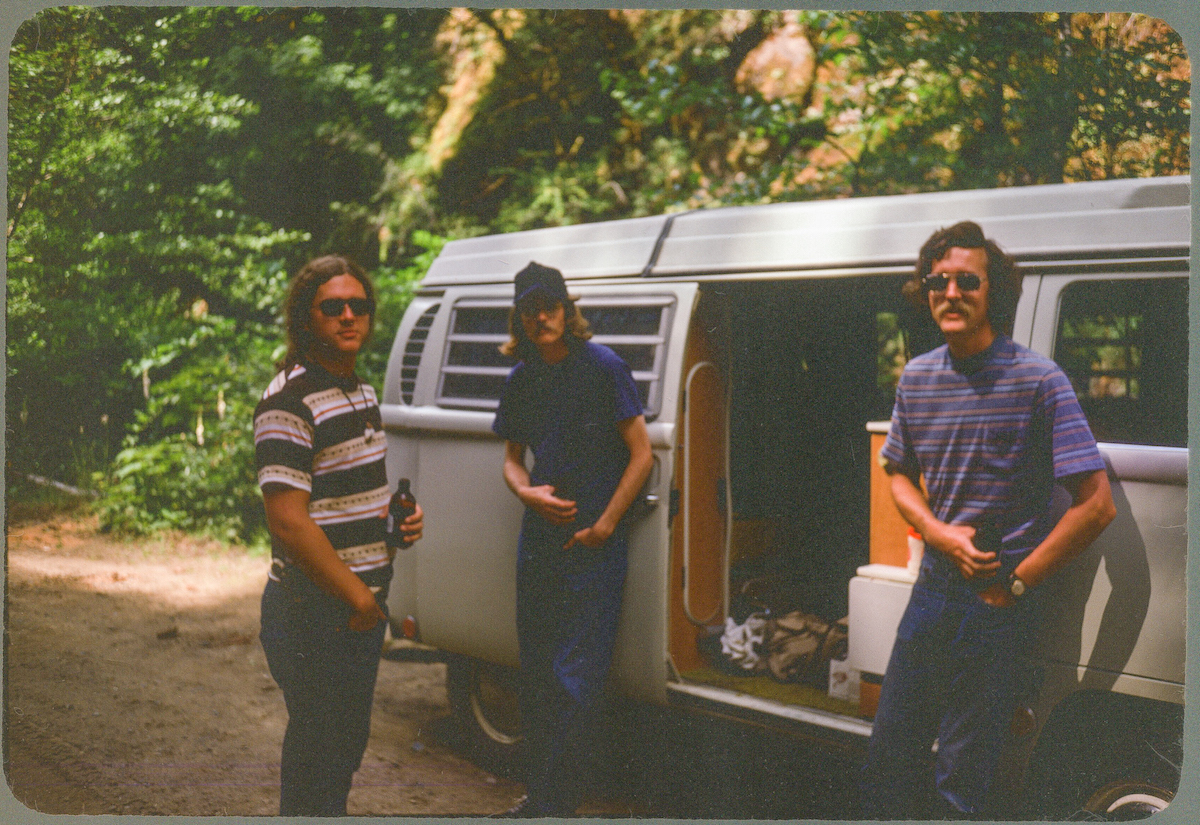 | Commercial tyers get into a meditative or hypnotic zone and every movement becomes automatic. Randall remembers early conversations when they were in the zone, “Dennis and I had lots of time to think and talk about any and everything. A recurring topic was how could we get more tyers and production? We would tie a fly for every song and commercial on the radio, and I mused that tyers should receive a royalty for their fly designs just like song writers and recording artists.” This was the first hint at the royalty program and motivated by the fact that they were tying almost exclusively for Orvis and not coming close to meeting the demand.
Dave Inks subsequently started a fly importing business and Dennis went to Africa to work with the factory, and to India and Europe. Jack Dennis remembers a long-distance call with Randall saying, “Dennis is looking for this mythical fly tying factory, it’s all he can talk about, a search, like Lord of the Rings.” Luck favors the bold and while in Madras, India, Dennis met A. Joga Rao who had a fledgling tying operation. Dennis invited Joga to spend several months in Oregon to tie flies with him, Randall, and others. Joga returned to Madras and eventually began producing quality flies.
“Jack Dennis and I knew that no one had succeeded at this before. Logistics and difficulties were monumental. Training tyers, procuring and shipping materials for every pattern is daunting. Ironing out every wrap of thread one pattern at a time and ensuring consistent quality is an hour-by-hour task. Operating in a foreign country and culture is a challenge, requiring patience and finesse. Import, export, licenses, customs regulations and duty are always in flux. Sales, financial obligations and stress are on-going, and paying for reject flies is demoralizing,” Randall recalls.
Black’s Custom Flies suffered a major fire in late 1972. Dennis temporarily moved into an A-frame cabin at Susan Creek along the North Umpqua River and began traveling extensively the next few years, spending time at Joga’s fly factory in Madras and collecting necks in Bombay and Calcutta. He also had exclusive distribution of Hoffman hackle and soon became the major hackle supplier to the industry, and flies were beginning to arrive. Umpqua Feather Merchants, as we now know it, came to be. | 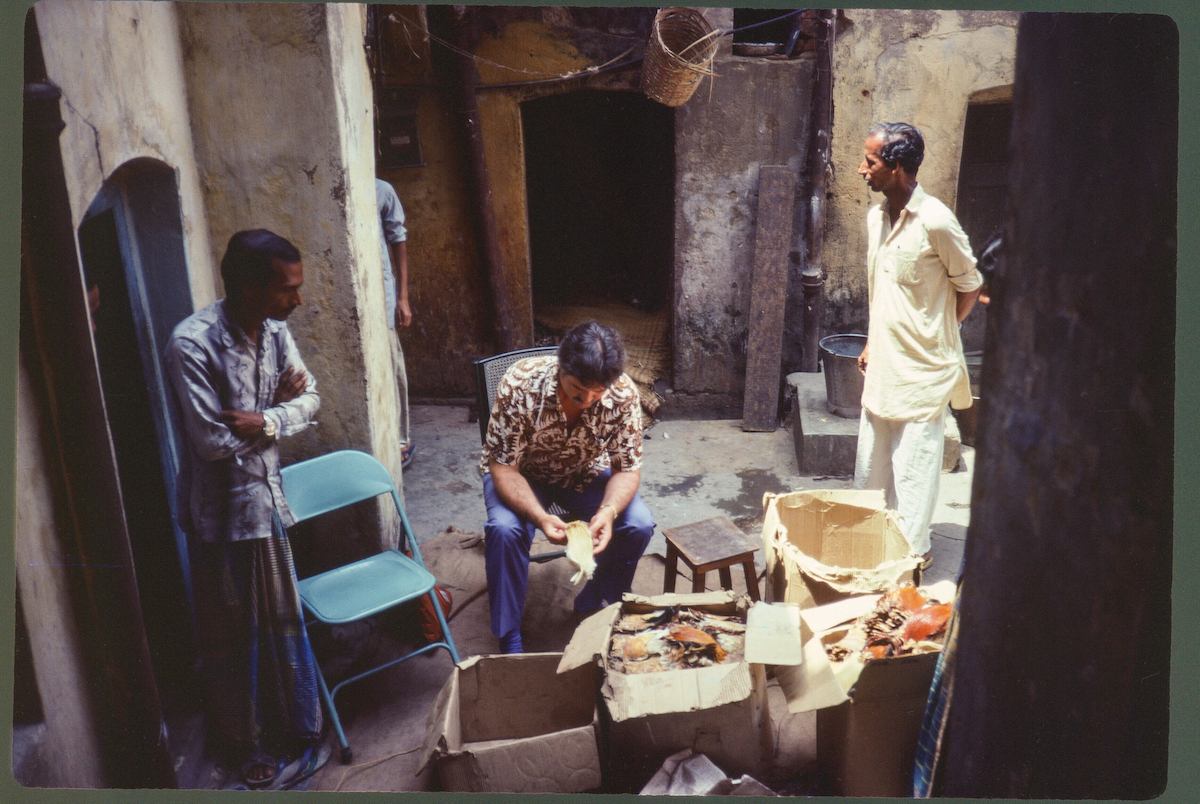 | Dennis high grading hackle in a back alley in India | | At the time Dennis had a VW van, hair down the middle of his back, and a plan. As Jack Dennis stated, “I remember going to Dennis’ place on Moore Lane in the mid 70s and the basement was filled with flies. So, I asked, what are you gonna do with all of these flies?” His plan was to take his fly inventory, load it in his red hippy van, and drive to every fly shop in the West in August when they desperately needed flies. The price of gas in 1968 was .38 cents and flies were being sold at shops for a 75 cents to $1. That summer he sold every fly at the first stop in Idaho and understood the opportunity. |
Stay tuned for more articles and stories about FFFC in future newsletters!
|  | |
Fly Fishing Film Tour April 2, 2026
2026 is the 20th anniversary, and will feature breathtaking, never-before-seen footage and inspiring stories that will leave you itching to cast a line.
Rod Building - Starting May 2, 2026
Larry Frede will be leading another of his great rod building classes beginning the first Saturday in May. The class will meet on Saturday mornings from 9:00 - 12:00. This is your opportunity to build your own custom fly rod! You will need to purchase your components - the club will provide tools and instruction. Please contact Larry Frede at larryf44@yahoo.com if you are interested.
Hume Lake May 9, 2026
It has been a few years since we have done this trip. It's a beautiful lake and a very fun area to spend the day. Stay tuned as put the finishing details together.
Roger Miller Youth Academy May 16, 2026
The Academy is designed for young people ages 11 to 15. Instruction will include casting, fly tying, conservation and a host of other skills offered by regional experts. The course includes education in fly fishing as well as fishing in local waters.
More Information Here
Small Creeks on the San Joaquin May 23-24
More information coming soon.
Marble Fork of the Kaweah June 28, 2026
The Marble Fork of the Kaweah River near Lodgepole in Sequoia National Park has proven to be a great spring fishery in recent years. Depending on conditions, we have see great dry fly, as well as nymphing success. This is a beautiful area and a great place to gather as a club and enjoy a day of fishing together.
Kern River Heritage Trout Challenge July 23-25
There are three of the Heritage Trout species in the Kern River Basin and Golden Trout Wilderness area. The Little Kern Golden west of the Kern River, the Kern River Rainbow in both branches of the Kern River and the California Golden Trout on the east side. We are planning a 3-4 day trip to pursue each of these three species. Stay tuned for more details.
Go Here to see our full Event Calendar and to register for events
| Product Reviews
Gear I Like | | Here is a relatively new product from upstart Colorado based Pesca Industries. This a rod tube rack. It’s a simple design that functions as advertised. My fly rod storage had been very haphazard and required that I dig around in my closet to find the rod that I was looking for. This problem was only exacerbated as my collection of rods increased over time. When I saw an advertisement from Pesca which showed their rod tube racks, I knew I had found what I needed. Since I store my rods and reels together in their tubes, I was looking for a horizontal storage option. I ended up purchasing three of the 3 rod tube units. | | | | Installation was easy once I was able to locate the studs in my wall for the attachment screws. There are a number of color options from which to choose and the units come in two sizes. The larger diameter fits cloth tubes (like the ones I have) or the smaller option for those who store their rods in metal tubes with reels not attached. The tube holders are made of plastic, probably manufactured on a 3D printer, but should hold up well with normal use. . Fly Rod Tube Holder: Triple Wall - Pesca Innovations In addition to the rod tube holder reviewed, Pesca has a number of other fishing related items in their product line. Customer service has been great as the company is a one-man operation. Free shipping on orders of $50 or more.
| | | | I have always wanted a pair of zippered front waders. The ability to simply zipper down to relieve myself streamside was a big plus. In addition, the large zipper makes putting the waders on and off a much easier proposition. Zippers are usually an expensive option found only in high end waders such as ORVIS, Patagonia or SIMMS. About a year ago Paramount offered their DEEP EDDY zippered waders at an almost too good to be true price of $149. I did my due diligence and checked product reviews and even watched a review on YouTube. Myself along with two other club members decided to buy these waders. Out of the box, the fit was great. The look and feel of these waders was as nice as any of my previous high-end waders (SIMMS and ORVIS). The on the water test on the Lower Kings went fine with no leakage even at the zipper.
Doubts about these waders started to creep in when I heard from Christopher Robbins that his Paramount waders had a major seam failure along the lower leg. He sent them back to Paramount and instead of replacement waders he was sent back the original with an Aqua Seal repair job. This seemed wholly inadequate given the extensive seam blowout. I kept my fingers crossed and hoped for the best. Luckily, I made it back from a week in Alaska with these waders still holding up. Soon after, on the Lower Sacramento River one of legs in my waders had a seam blow-out in the same manner as Christopher’s. I didn’t bother with customer service and did the repair myself. Fast forward to last week and on the Upper Kings and the opposite leg has now had a seam open up. If this had only happened to me, I might be willing to write it off as a fluke. But to have it happen to two of us in the exact same spot is a lack of quality control at the company level. I am sold on zippered waders but my next pair will be from ORVIS and sooner rather than later. | 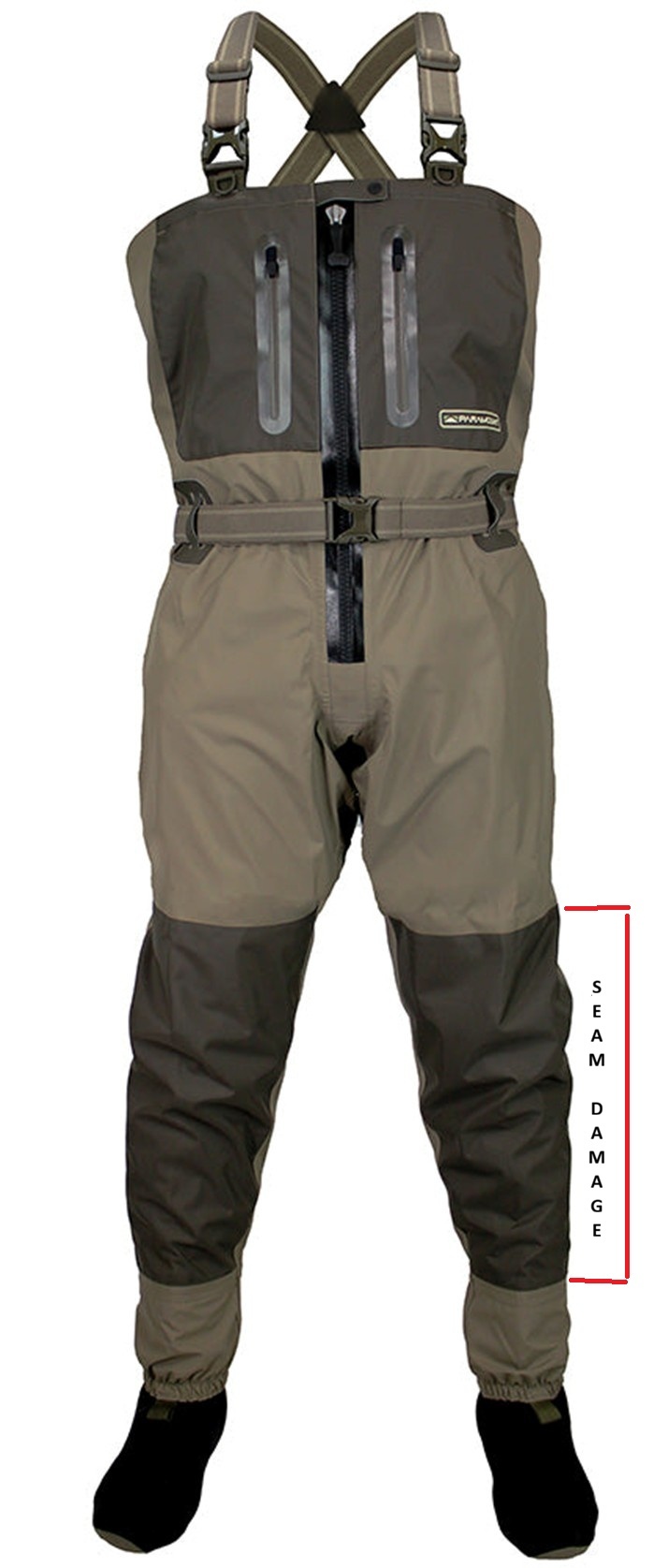 | | | Back of Beyond Stephen Neal
In Wildness is the Preservation of the World - “Henry David Thoreau."
| I required healing. I required wildness. I found them while camping on the Olympic Peninsula, alongside waters of the Strait of Juan de Fuca. It, Georgia Strait, and Puget Sound form the Salish Sea, which is marginally encapsulated by Washington, Vancouver Island, and the mainland of British Columbia.
This coastal land of rainforest, mountains, rivers, streams, lakes, and surf-carved bluffs was the medicine that my weary soul needed. I visited the area with my good friends Sean and Greg. Our nights’ slumbers were aided by the sounds of storm-tossed waves, and our cares were eased by footfalls through rainforest and beside ocean-sculpted headlands. It was the first week of March 2026. Day-time highs were in the low 50’s (10’s Celsius) with lows pushing freezing. Sunday, Monday, and Tuesday were filled with sunshine. Pacific storms were pushing shoreward, and heavy rains were predicted for Tuesday night and Wednesday morning. On-shore winds required us to don multiple layers of clothing and hooded tops. We carried rainwear in our day packs along with our lunches. | | Salt Creek Campground (west of Port Angeles)
My Sunday afternoon footsteps on the wet trail transmitted information and gravitational forces to my body through the soles of my shoes. My feet felt the granular nature of the cliff-side footpath. The squish and mild suction as I crossed rain puddles. The flex of my feet as we gained or lost elevation. The twist of my lower body as I changed direction. The jarring impact as I descended hand-shoveled cut steps. The bunching and heat of unused muscles as I regained lost elevation.
I stopped often to photograph the rocky, rugged coastline. The evergreen forest with witch’s hair lichen adornment along with the Red Alder and Bigleaf Maple trees that hung precariously from sandstone and volcanic cliffsides slowed my steps dramatically. These images caused me to pull my iPhone camera from my pants pocket. So distracted by the rich photographic environment, I set my wadding staff down one too many times and lost track of it, necessitating a step-by-step | 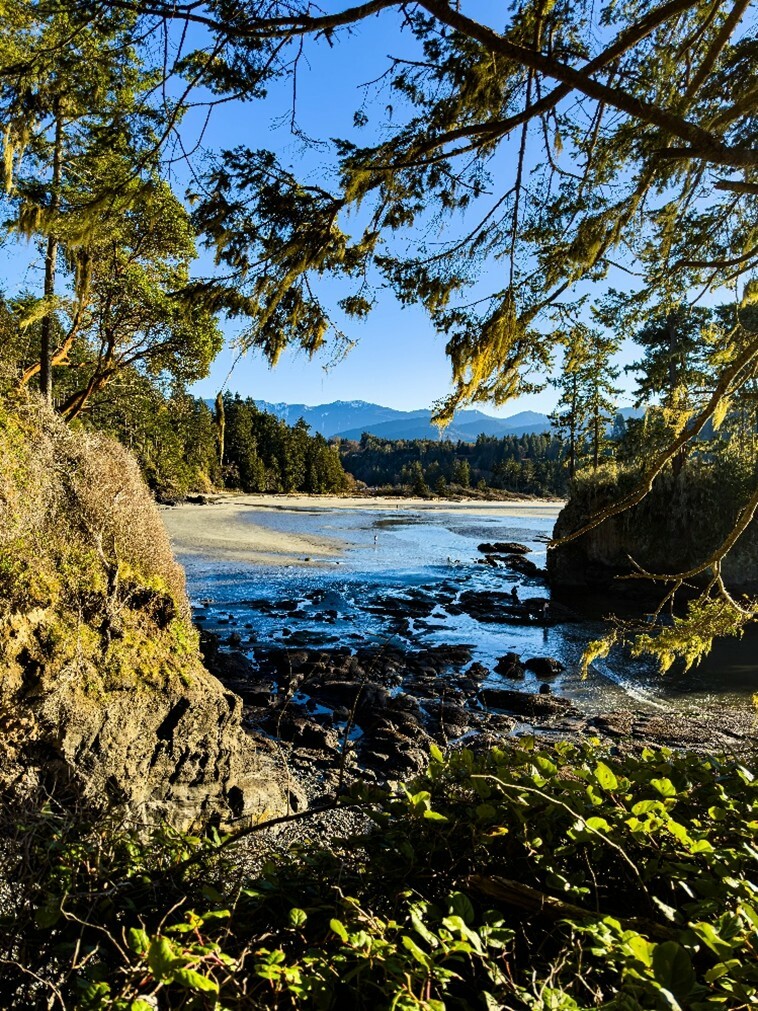 | | | Salt Creek Campground - Olympic Peninsula
retracing by Greg and myself to recover it. For the remainder of my stay, I tethered it to my belt loop. In addition to the feedback from my footfalls, my ears were filled with the sounds of forest winds, crashing waves, and bird calls. The rich smells of damp earth, trees, moss, and salt air with a tang of iodine assailed my nose. The Strait’s waters displayed passing container ships and small commercial fishing boats, adding to the maritime ambiance.
Lyre River (source: Crescent Lake. mouth: Juan de Fuca Strait)
| | Monday’s hike was along the Lyre River. The mud in the campground trailhead had a slick, claylike element, compromising our footing. The forest canopy was Red Cedar and leafless Red Alder trees. Faded fall leaves still littered the ground, adding their wet slickness to the footing. The climb out of the Lyre had me dogging it, but I managed my physical resources by stopping when necessary and purposely drinking in the beauty of the alder forest meadowlands. Scattered birdsongs teased the quiet of the forest, though I never did catch sight of these little music makers. Their musical notes originated from a backyard pool-sized marshy pond. | | | Lyre River - Common Merganser
Emerald-green light reflected from the pond’s surface beneath a wintery blue sky. The white trunks of the alder trees surrounded the scene.
My muscles eased as I trod through the alder bottom. From there the trail passed into a spruce and fir forest, with cedars and maples rounding out the mix. Here we lost elevation, rejoining the Lyre River as it returned to Mother Ocean. The trail emerged from the forest canopy onto the Lyre River’s delta. Full winter sunshine greeted us and so did the wind, which was being pushed by the approaching Pacific stormfront. Wind and waves filled the sound spectrum, accented with the cries of seagulls. On a carved log bench, we took our lunch. We had come for the birds, so we took cameras in hand and began to shoot.
On our return journey my starboard boot added a new wrinkle, as the sole delaminated. A roll of athlete’s tape from my first aid kit kept it attached until we made camp, so all was good. However, the feedback from my footsteps on the starboard side was degraded.
Barnes Creek (source: Olympic Mountain Range. mouth: Crescent Lake)
Tuesday was cloudy and threatening rain. We drove inland, skirted the southeastern edge of Lake Crescent, and exited the truck at Barnes Creek terminus. The footing was firm and the day quiet until we pierced the fringe of trees at the lake’s edge. The wind began to howl as whitecaps and spray sailed across the lake’s surface. Waves slapped the shoreline as evergreen tree limbs thrashed in a noisy dance. As the temperature fell, I briefly considered adding another layer but instead pulled up the hood of my jacket. The wind proved short-lived though, as it died as we ducked back into the forest to follow the creek, and the hush of the forest returned. Here, in the peaceful wood, we followed the contours of the creek as it wove through the old-growth forest. The alder trees here were huge, their size striking an expression of protected age. Alder bottoms, as they are called, are usually shorted lived in this land of heavy rainfall. Floods are the perpetrators of their early renewal.
Deeper in the rainforest the granular footing of the trail became soggier, almost spongey. Squishes announced our footsteps as we advanced deep into the forest. Trees’ lichens became thicker, almost bulbus in shape as they | | wrapped around the trunks and limbs. They resembled green lambswool insulation. A misstep and a brief brush with the lichen would result in soaked clothing.
At the trail junction to Marymere Falls we encountered a gathering of fair-weather hikers sussing out the prudence of continuing the steep climb to the falls. Their voices overrode the silence of the forest and the quiet trickle of creek water. We wove our footsteps through the indecisive gathering and soon left the press of humanity behind, thus regaining the silence of the old growth rainforest.
Shortly beyond the Marymere Falls trail divergence we began to gain elevation as the creek gradient increased. Our views of the creek took on a game of peek-a-boo as we ducked under and climbed over fallen trees. The trail steepened dramatically and Sean, astutely gauging my strength, recommended we husband our resources for the climb up to | | | Barnes Creek - Olympic Peninsula
Marymere Falls. We turned around at a small freshet that bubbled a happy tune. On our return to the intersection we were pleased to learn that the crowd of indecisive off-season hikers, disenchanted by the steep climb, had vacated the area. The view of a large torrent of falling water had fallen short as an enticement. We took advantage of the now sparsely occupied back-country trail and ascended to Marymere Falls. At the steepest section I dropped my hiking speed down to granny-gear low and chanted the Backpacker’s Prayer: “Dear Lord, if you will pick them up, I will put them down.” Still, I had enough air to enjoy the forest’s beauty as we climbed. The trail was in good shape and remained dry until we drew near the falls. Had this been spring-, rather than winter-runoff, we would have been crushed by throngs of fair-weather hikers. Instead, we were rewarded with a quiet, peaceful visit and ample space for photographs from prime viewing spots.
Mouth of the Elwha River (source: Olympic Mountain Range, mouth: Juan de Fuca Strait)
A rainy Wednesday began shortly after midnight and continued until just before noon. Scattered storms were predicted for the rest of the day. After packing our raingear, we headed for the mouth of the Elwha River. The access trail leaves from an improvised parking spot at the end of the road. It was littered with rain puddles, some of which were quite deep, showing evidence of heavy use by beach enthusiasts and residents. A row of beach houses lined the road that lies at the base of the cliff face and stretches the length of the newly evolving river mouth. A recently formed delta (a result of the breaching of dams on the river) marks the river’s mouth. In its current configuration the delta has built up a large beach in front of the houses, providing protection from the tidal influence and marine traffic that passes through the strait.
| | Our visit introduced us to a building boom that is taking place on all the new beachfront. Driftwood castles have popped up like early spring daffodils and jonquils. The trail sits atop a raised dike that follows the river channel and dumps one off onto the beach that extends into the Strait. At this point a hiker has a choice; either turn right to the river’s terminus or turn left and hike along the quarter-moon shaped bay in front of the new shoreline and its multi-roomed driftwood domiciles. It is a nice walk on | | | Elwha Delta Pound
wet sand; otherwise, it is slog through the very loose noncompacted sand deposits. The oceanfront view is stunning.
Ruminations
Just like us, the earth is a living, breathing entity. It expands and contracts, boils over and explodes, readjusts and renews. It breaks down and decays, hurts and heals. It is in a constant state of change, sometimes very slowly and at other times abruptly. It freezes over and it steams. We are of the earth, and it behooves us to judge ourselves accordingly. Humility and forgiveness serve us well in dealing with our fellow man.
With human frailty I have described my time on a small portion of the Salish Sea. I hope my descriptions, which are but whispers of the mind, have given it life. Yet there is no substitute for being here. According to PBS’s Nova, our eyes capture only 0.0035% of the world around us, so is it any wonder that we miss so much in our viewing of the world? Take the time to slow down and heal yourself with a closer look. You will be happier and richer if you do.
| |
A Big Thank You, to Tennis Terrance for his editing suggestions.
Thanks to Sean Gallagher and Greg McDonald for sharing the journey.
“The world is out there, the journey starts the minute you leave the door, go outside and truly live.” – S. Neal
“When given the choice between being right or being kind, choose kind – Dr. Wayne W. Dyer
“Many go fishing all their lives, without knowing that it is not fish they are after” - Henry David Thoreau
|
Discounts
California Fly Fisher Magazine
Use Code FLYCLUB to receive a $5 discount on a subscription.
Here are a few additional links to other information and websites you might find useful:
|  | ABOUT US
We are a Fly Fishers International affiliated club, a national organization whose goal, like ours, is to promote the wonderful sport of fly-fishing as well as protect our natural resources. We promote catch and release, education, conservation, and above all, encourage and help those who desire to learn more about all aspects of fly-fishing.
Fly Fishers for Conservation (FFFC) was organized in 1961 by a group of devoted fly fishers deeply concerned with the preservation of trout and all game fish, their environment, and the quality of fishing. Our club has maintained two goals since that time: To foster and promote the sport of angling with artificial flies. To protect, conserve and increase our angling resources.
Go Here if you would like to join our club!
Fly Fishers for Conservation is a 501(c)3 tax-exempt non-profit organization. This means you can use your contribution as a tax deduction. The club gets revenue from member-ship dues and the annual fundraiser dinner. We try to contribute to conservation issues in the area and to our youth with our Trout in the Classroom program, the No Child Left Inside program and by holding a Youth Fly-Fishing Academy annually. The club is al-ways in need of funds. Please consider donating. You may send a check to Fly Fishers for Conservation at PO Box 1192, Clovis, CA 93613. Your donations will be greatly appreciated and they will help the club fulfill its obligations.
|  | | Support received from the following.... | |