Fresno Fly Fishers For Conservation
Sixty Five Years and Counting...
| | Fly Dope Volume 65 Issue 07 | | | Editor's Note:
Welcome to the July 2026 FFFC Newsletter!
Please Note:
Downloadable files of the newsletter will be available in our club's Document Library within a few days of the newsletter's release. Here is a link: Fly Dope Newsletters
Tight Lines!
Mark
|  |
July 2026
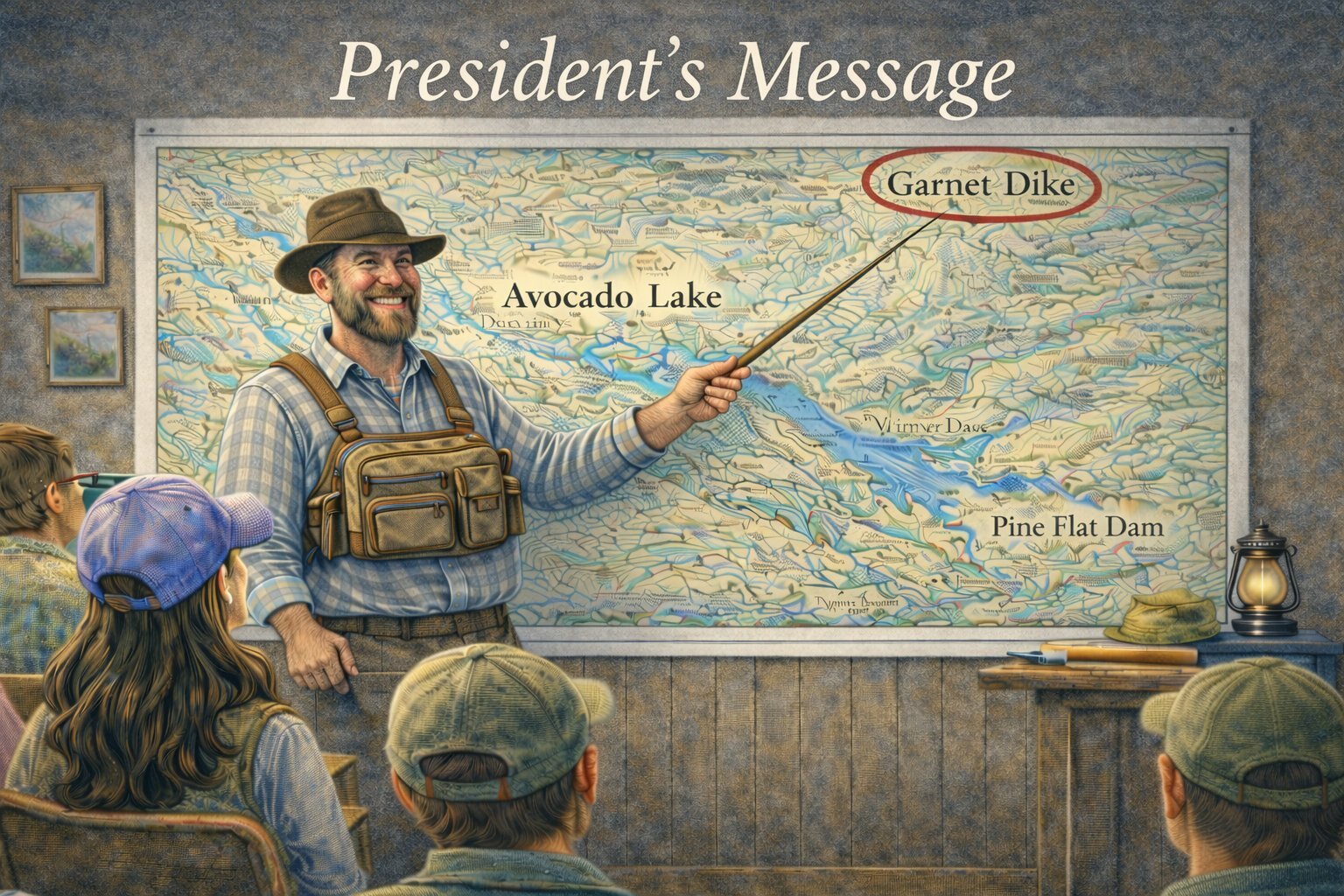
Most Adventurous FFFC Members,
One of the greatest joys of fly fishing is watching our passion transform into a legacy. This month, we are incredibly fortunate to have FFFC Board Member Gavin O’Leary and his son, Cael, presenting on the California Heritage Trout Challenge. Their journey is a beautiful testament to the multi-generational spirit of our sport. Gavin made history back in 2008 as the 100th angler to complete the challenge, and just this past October, Cael crushed his own second milestone quest.
Two years ago, I took one of my sons on our quest to catch the three Redbands and we successfully netted all three. And last year, Cael, Gavin, my daughter Mari, and I had our own three-day adventure fishing for the Little Kern Rainbow, the Kern River Rainbow, and the California Golden. It was a blast.
This parent-child fly fishing experience represents the true heart of our club. The Fresno Fly Fishers for Conservation isn’t just a group that meets to swap fly patterns, listen to speakers, and tell stories; we are a living repository of knowledge, mentorship, and shared history. Our mission is to pass down not only the skills required to read pocket water, but also the deep conservation ethos needed to protect the 11 native trout strains that call our state home.
As we head into the heart of summer, I challenge each of you to keep this legacy alive. Grab a child, a grandchild, a buddy, or a new member. Map out an adventure, hunt for a native strain, and start your own heritage quest.
Tight Lines!
President
| Thursday July 2nd 7:00 - 9:00 PM
Provost & Pritchard Office Building
Topic: California Heritage Trout Challenge (HTC)
Presented By Gavin and Cael O'Leary | 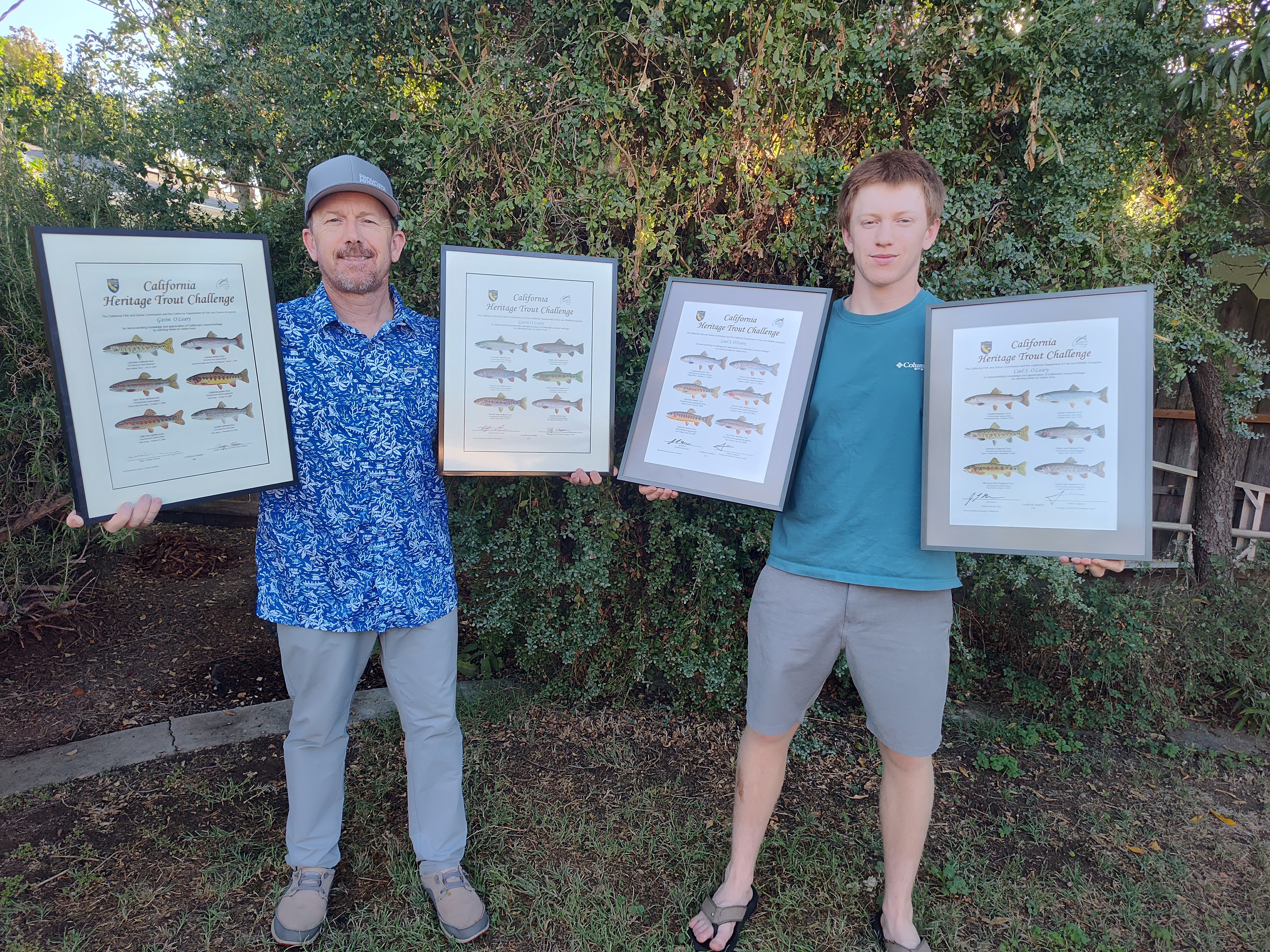 |
Did you know our state has 11 scientifically distinct native trout forms? Believe it! These trout fall into three categories: Cutthroat, Rainbow/Redbands, and Golden Trout. Wow, you’re already soaking up knowledge to use at summer pool parties or meeting new friends on the river.
Two dedicated fishheads, FFFC Board Member Gavin O’Leary and his son Cael ,will be teaching everything you need to know about the California Heritage Trout Challenge (HTC). Their insights come from completing 4 successful quests… with Gavin being the 100th angler to successfully finish the Challenge (way back in 2008) and Cael completing his second Challenge in October 2025.
We’ll cover these topics and more:
-
Overview of the HTC and why you might want to do it
-
Details about each qualifying fish (what and where)
-
Trip planning and what to expect while searching for trout
-
Insiders tips and how to get the most out of your quest to complete the Challenge
You don't want to miss this, See You At The Meeting!
| A few images from our June 27th outing
at the Marble Fork of the Kaweah | Tim Lawrence and his son Eric.... | 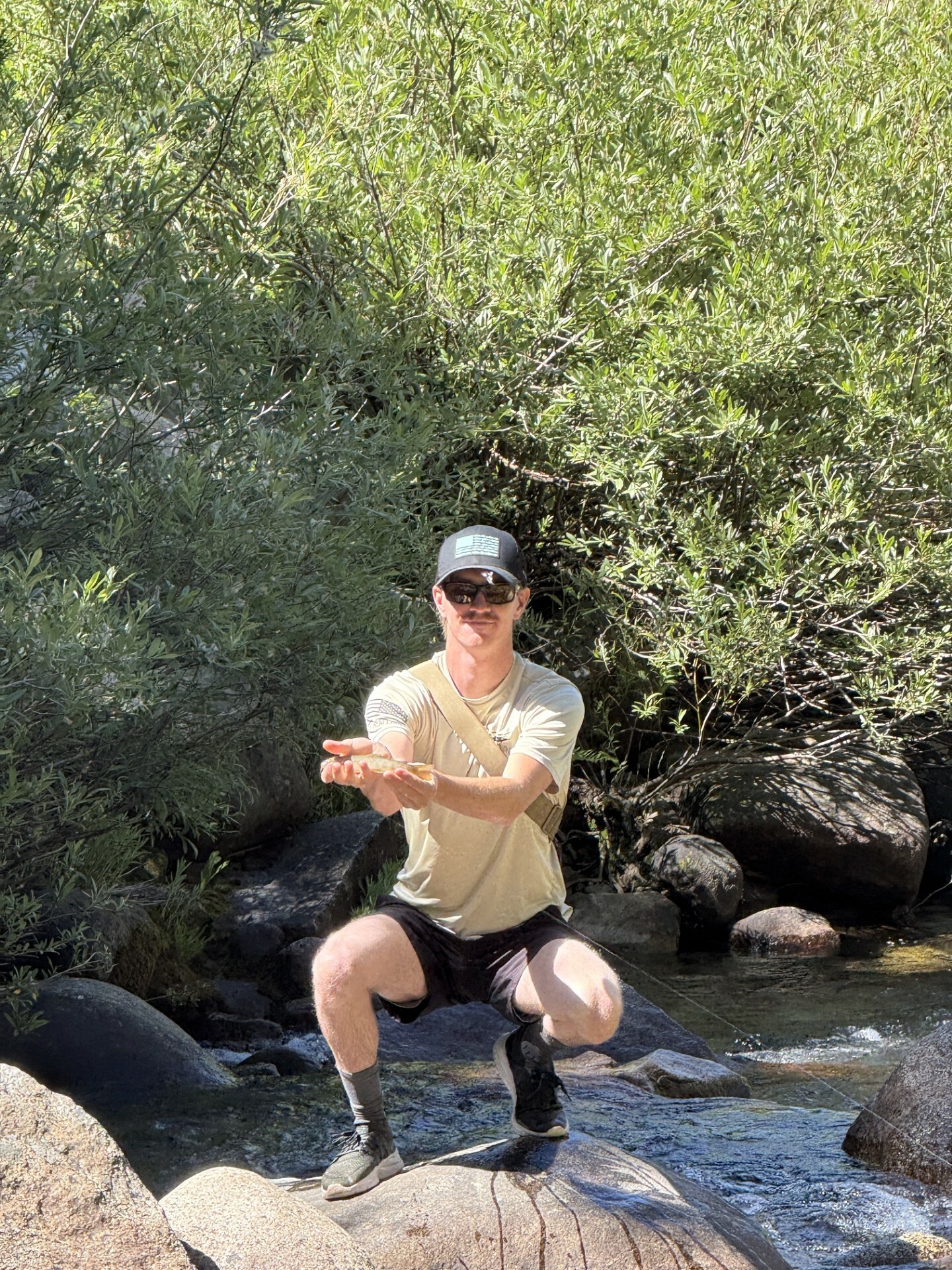 | 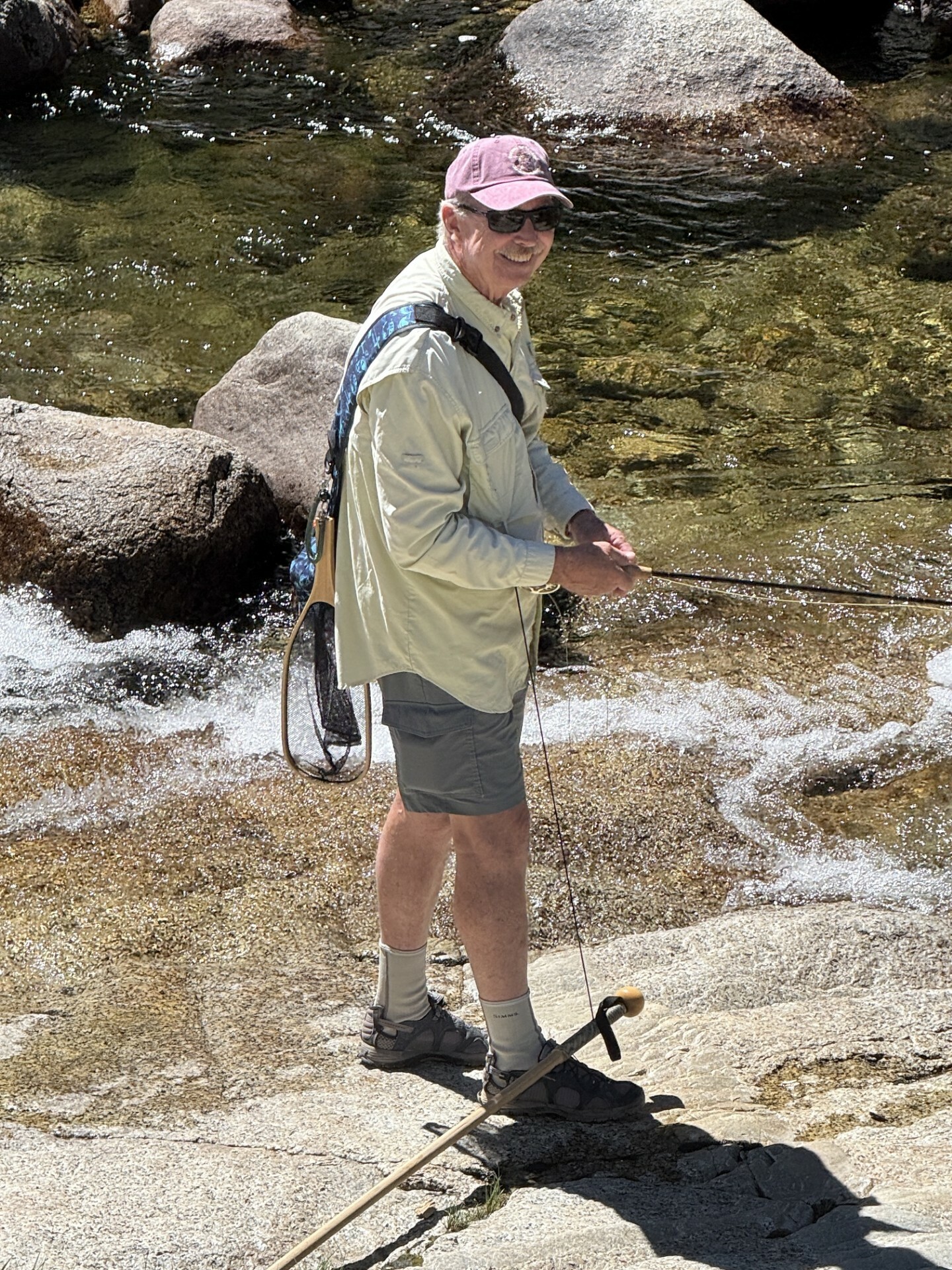 |  | |
Golden Trout/Kern River Basin July 23-25
The goal of this trip is to have fun, be safe, and successfully catch and release three unique heritage trout subspecies over three days. Kern River rainbow, Little Kern golden, and California golden trout. Two of the trout are casual roadside fishing. One requires an extensive hike into and out of the Kern River canyon. You must be in good physical condition and a practiced hiker for to this outing.We will be car camping for two nights at a single unimproved site (you supply your own camping gear). We will be carpooling, an off-road vehicle is recommended but not required. This trip is limited to 6 participants. Text Gavin O'Leary if you have any questions. Registration required. Register HERE.
Cedar Grove - South Fork of the Kings River September 18-19
The South Fork of the Kings River in Kings Canyon is one of the premier areas to fish in the Central Sierras. CA-180 drops into the canyon near Boyden Cavern and runs parallel to the river for 15 miles to Roads End. The fishing options along this 15 miles (and more if you're willing to hike) are diverse and plentiful. With great pocket water, riffles, side channels and soft water you can find success with dry fly, dry dropper, indicator nymphing and tight line nymphing. You can even find some holes to pull a streamer through. More detail to come as we get closer. Register HERE to let us know you are interested.
East Side - Lake Crowley and the Owens River TBD
The East side is loaded with great fishing options. The Upper and Lower Owens Rivers, Hot Creek, Crowley Lake, high mountain lakes and streams. This is a weekend trip you will not want to miss. We encourage you to stay at Tom's Place near Crowley Lake. This is a rustic lodge with great history and in a great location.
Go Here to see our full Event Calendar and to register for events
| | Diving Deep into the Rabbit Hole | Not much has changed since when I was back in school. I have put off an assignment way longer than I should have. This monthly column is supposed to be in our Editor’s inbox no later than the 20th of each month. As I type this, it is Father’s Day, June 21st. I’m sorry Mark. Like everyone on our Board, I work for free. The chance of me getting fired is pretty low. Anyway here it is.
[Editor's Note: One day late, and you send it on Father's Day! We look forward to your column Bill - even if it's one day late....]
“Once you start tying your own flies you’ll save tons of money at the fly shop”, said no one (truthfully) ever. Let me relay to you my latest foray into tying a fly that I just had to have. The story starts with the booking of a guided trip into Cheesman Canyon to fish the South Platte River in my newly adopted home state of Colorado. The trip is scheduled for mid-July. Wanting to be prepared as I could, I went into my favorite local fly shop, Charlie’s Fly Box, to get some local intel.
I went into the shop hoping to find a few favorite “guide” flies. You know, the super easy to tie, few material flies that guides tie the night before a trip, that catch fish. Sam, the very helpful shop employee, was more than willing to help me with fly selection. It turned out that Sam and I had different ideas about what a guide fly is. He picked out the Killer B fly. It is a very accurate rendering of a yellow jacket wasp. The shop owner and former guide, Charlie Craven came up with the pattern after pumping the stomachs of a few South Platte trout and finding at least one yellow jacket in many of the fish. This pattern would allow me to fish a fly that these heavily pressured fish rarely see. Sam had me hooked.
Lucky B - Fly Tying Instructions by Charlie Craven
“Why don’t you set me up with the materials I would need to tie this fly”, I told Sam. Off we went on our quest. You’ll need hooks, yellow foam, tying thread, leg material and macramé yarn for the wings. I was on board until we got to the macrame yarn. Sam pulled packs of yellow, rusty brown, gray and tan yarn. I stopped him and asked, “Why do I need so many colors for the wings?”. “You have to blend them together to get the accurate color needed to match the natural and they’re only $3 each.” There was no turning back now.
Mixing Polypropylene Macrame Yarn Custom Colors For Fly Tying
I went home and looked up how to tie this new fly. It turns out I needed still more materials to be able to finish this fly. The foam abdomen is tied on a sewing needle. It turns out single sewing needles are hard to come by. I had to buy a small sewing kit that contained the needle I needed. The macrame yarn wing material needs to be separated and combed out in a time- consuming process using a wire dog brush. I don’t own a dog. Off to AMAZON to get the brush.
Did I mention that yellow jackets have a unique pattern of black chevrons on their bodies. A fine Sharpie marker rounded out the list of materials I would need to tie this single pattern. Let’s break it down:
| | Yellow Foam $ 3.00
TMC Hooks $10.15
MFC Barred Sexi Floss $ 4.50
Macrame Yarn x 4 $12.00
Yellow Uni Thread $ 5.00
Sewing Kit $ 4.95
Fine Sharpie Marker $ 2.00
Wire Dog Brush $12.00
| | | Cost for materials needed = $53.60. The process of tying a new must have pattern, priceless.
Postscript – A single Killer B fly retails for $3.50. Don’t tell my wife, please.
| Back of Beyond Stephen Neal
In Wildness is the Preservation of the World - “Henry David Thoreau."
| Two Million Year Cycle of Change and a Disappearing
Mountain Range
| | Twenty in number are the major volcanoes that are the “current” crystalline crown jewels of the Pacific Northwest’s Cascade Mountain Range. The Cascades are forty million years old. Interspaced within the mountain range are four-thousand volcanic vents. There are also ghost volcanoes that are located around the current twenty major volcanoes. Of the twenty major volcanoes are fourteen whose names are recognizable to those of us who live in the area from Southwest British Columbia to Northern California. Here are both their present identification | | | Mount Rainer wearing a Cloud Sunshade - Near Buckley, WA | |
and their Native American names, as the Cascades’ history predate European place names. Starting from just outside Sacramento CA., going north, they are: Mount Lassen - Kukaklek, Mount Shasta - Uytaahkoo, Crater Lake / Mount Mazama - Giiwas, Mount Jefferson - Seekeekqua, Mount Bachelor - Klah Klahane, Mount Hood - Wy’East, Mount Saint Hellens - Looit, Mount Adams - Klicktat, Mount Rainer - Tahoma, Glacier Peak – Dahkobedc, Mount Baker – Kulshan, Mount Garibaldi – Nch’kay, and Mount Meager – Qwelqwelusten.
These majestic conic beauties draw the eyes of all that view them and figure prominently in the oral history of Native American tribes. I use the term “current” in this discussion because while the Cascades Mountain Range is forty million years old, the current volcanoes are only around for two million years. Over the mountain range’s forty-million-year history, many crown points that have come and gone and are supplanted by new volcanoes.
In an approximate two-million-year cycle, new volcanoes arise and eventually erode. We know this because of a professor of geology from Portland State University. Paul E. Hammond spent 58 + years studying the geology of Mount Rainer and its surrounding area, collecting samples, and mapping the area. His field research revealed the presence of ghost volcanoes and opened a new and deeper understanding of the geological history of the Cascade Mountain Range. | | We now know that there was a range of volcanic peaks that ran along the Pacific Coast from Alaska to Mexico. They were created by the Farallon Plate subducting beneath the North American Plate. You may be asking yourself “What Farallon Plate?” Well, that plate disappeared under the North American Plate. Only a small portion still survives to create the heat necessary to form magma and the resulting volcanos along the Pacific Coast. (To further expand your awe of our living planet, the crust of the Farallon Plate bubbled up like a cork one-thousand miles east, and formed the Rocky Mountains). The remnant of the Farallon Plate is the Jaun de Fuca Plate, which sits fifty mile off the Pacific Coast, stretching from Vancouver, B.C. to Northern California. | | | | Mt. Rainer sunset from Filucy Bay, Key Peninsula, picture by Barbara Gallagher | Your next question very well might be “Where are the volcanoes that stretched from Alaska to Mexico?” Once the Farallon Plate completely submerged, the heat that formed the magma necessary for volcanic eruption died. This let the magma chambers beneath the volcanoes cool. Those giant magma batholiths beneath the volcanoes turned to granite. That granite makes up the Sierra Nevada Mountains. Erosion and uplift have brought those magma batholiths to the surface, and they are now the sawtooth shaped peaks of the Sierra Nevada Mountains; they are ghost volcanoes. (Note: Not all magma batholiths form granite, as the exposed batholiths of the ghost volcanoes around Mount Rainer are diorite.)
In five million years our Cascade Mountain Range will disappear, the Jaun de Fuca Plate will complete its subduction beneath the North American Plate, and the heat engine that produces the volcanic Cascade Mountain Range will cease. The magma chambers below the volcanoes will cool, and in time a mountain range like the Sierras will replace the Cascade Mountain Range. Its peaks will be diorite instead of granite. The Pacific Northwest will become a geologically quiet area, since the Pacific Plate is moving away from the North American Plate and subduction will cease along our section of the Pacific Rim.
As a resident of the of the Pacific Northwest, I am fortunate to have visited five Cascade Volcanoes. The two I am most familiar with are Tahoma (Rainer) and Uytaahkoo (Shasta). I live on Tahoma’s skirt and spend a week in the fall each year with friends fishing the waters of Uytaahkoo. Both volcanic mountains create their own weather, and most days they are attired in moisture-rich clouds. On moody days they “mis-appear”, (a word coined by Colin, my grandson, that I have appropriated, much to his chagrin), and they are gone altogether for | | weeks at a time. When they reappear, their regal beauty dazzles all who view them.
Unfortunately for us the Cascade volcanoes are losing their glaciers. Rainer in the summer months demurely displays her bare shoulders. Distressingly, Shasta appears naked. Throughout the year when Rainer is visible, she wears various clothing. One moment she displays her clouds as a hat. Moments later the hat becomes a scarf. Later the scarf may become a cape, shawl, wrap, or even a full dress. As I write she is on full display, | | | Mount Hood from Justesen Ranch, Grass Valley OR.
Bob is in his banana pontoon boat | with her full-body snow cover shimmering in the full sun of late spring. Her forested skirt is dark green, accentuating the snow-white color of her blouse. In the fall her skirt is speckled with yellow as the aspen, maple, and cottonwood trees transform from green to gold. Once their leaves drop from the speckles of brown appear, adding to her skirt’s hunting tweed appearance. I imagine that Shasta displays many of the same attributes.
Our natural world fascinates me. Each time I learn something new I see the world from a unique perspective. A mountain is not just a mountain; a footprint is not just a footprint, nor a leaf just a leaf. Each is a new pathway to understanding, to growth, and insight. Nothing in life is one-dimensional; the more one changes one’s point of view, the more life reveals. Hundreds of things must come together for a fish to survive and procreate in a lake, river, or stream. Hundreds more are required for fisherman to catch one.
Do not take your life or our earth for granted. You may never pass this way again. Even if you believe in reincarnation, you will be different then than you are now. This is your only chance to see the world that is here and now, with you as you are at this moment. Whatever your circumstance, look deeper. That you are here is a miracle. Consider the process of conception when a single egg unites with a single sperm. A female has approximately three-hundred-thousand eggs during the fertile period of her life. Each male ejaculation has about three-hundred-million sperm. That equates to a hundred-thousand-billion different combinations of DNA. You are just one of those one hundred-thousand-billion different combinations. Embrace the wonder and beauty of the moment; always stay curious and get outside. There are mountains out there and they touch your life in more ways than you will ever know. Life is a journey, not a destination. | |
A Big Thank You, to Tennis Terrance for his editing suggestions.
“The world is out there, the journey starts the minute you leave the door, go outside and truly live.” – S. Neal
“When given the choice between being right or being kind, choose kind – Dr. Wayne W. Dyer
“Many go fishing all their lives, without knowing that it is not fish they are after” - Henry David Thoreau
| | Sources: Alan Lightman – physicist and professor – MIT, Nick Zentner – Geology Professor – Central Washington University, Paul E. Hammond – Geology Professor Emeritus – Portland State University, NASA – The Farallon Plate. | | Mount Rainer from Lake Tapps, WA |
Here are a few additional links to other information and websites you might find useful:
|  | ABOUT US
We are a Fly Fishers International affiliated club, a national organization whose goal, like ours, is to promote the wonderful sport of fly-fishing as well as protect our natural resources. We promote catch and release, education, conservation, and above all, encourage and help those who desire to learn more about all aspects of fly-fishing.
Fly Fishers for Conservation (FFFC) was organized in 1961 by a group of devoted fly fishers deeply concerned with the preservation of trout and all game fish, their environment, and the quality of fishing. Our club has maintained two goals since that time: To foster and promote the sport of angling with artificial flies. To protect, conserve and increase our angling resources.
Go Here if you would like to join our club!
Fly Fishers for Conservation is a 501(c)3 tax-exempt non-profit organization. This means you can use your contribution as a tax deduction. The club gets revenue from member-ship dues and the annual fundraiser dinner. We try to contribute to conservation issues in the area and to our youth with our Trout in the Classroom program, the No Child Left Inside program and by holding a Youth Fly-Fishing Academy annually. The club is al-ways in need of funds. Please consider donating. You may send a check to Fly Fishers for Conservation at PO Box 1192, Clovis, CA 93613. Your donations will be greatly appreciated and they will help the club fulfill its obligations.
|  | | Support received from the following.... | |