Fresno Fly Fishers For Conservation
Sixty Five Years and Counting...
| | Fly Dope Volume 65 Issue 10 | | | Editor's Note:
Welcome to the October 2026 FFFC Newsletter!
Tight Lines!
Mark
|
October 2026
Most Amazing FFFC Friends,
I grew up in the mountains of Utah, that funny state just east of Nevada. My mother taught me to fish on the rivers in the Uinta and Wasatch mountains. It's a beautiful state, with rugged mountains and forests, amazing plateaus, and red rock sandstone and deserts that leave you breathless. I've now lived in California for nearly fourteen years. It was a reverse immigration of sorts, and as I've fished the rivers from the Kern to the Oregon border, I've been awestruck by the natural environment we enjoy in the Golden State.
| | Within the last month I fished the rugged peaks above 10,000 feet near Lee Vining, the stunningly beautiful and meandering Tuolumne in Yosemite National Park, the challenging, boulder-filled Merced outside the west entrance, and the South Fork of the Kings River in that glaciated canyon where granite towers above you like intimidating sentinels. While I enjoyed those rivers and used a complete arsenal of euronymphing, dry-dropper, and even tenkara during this adventure, my fishing was consistently interrupted by an appreciation for my surroundings. | | | | Consider that California has over 30,000 miles of active fisheries, with nearly 200 distinct, named rivers and key tributaries that offer amazing fly fishing. These rivers and streams are located in the following areas, which take your breath away for their natural beauty: Cascade and Mount Shasta region, featuring deep turquoise volcanic pools, basalt canyons, old-growth pine forests, and, of course, the view of 14,000-foot Mount Shasta; the High Sierra Nevada with its glacial granite gorges, massive granite domes, pine forests, and alpine meadows; the Eastern Sierra with its wide-open sagebrush valleys framed by 12,000-foot jagged granite peaks rising straight out of the valley floor; and the Pacific Redwood Coast with its temperate rainforests, ancient coastal redwoods, foggy river canyons, and crystal-clear coastal water.
| | |
We are blessed!
While you focus on that size 18 Adams, hoping for a twenty-inch Rainbow rise, don't forget to look around you and appreciate where you are. We don't just fly fish to catch fish; we fish to be in something so much bigger than ourselves that we simultaneously feel, ironically, insignificant and, yet, important.
Tight Lines,
Christopher Robbins
President
|
Thursday October 1st 7:00 - 9:00 PM
Provost & Pritchard Office Building
| Fishing the East Side of the Sierras
with Fred Rowe | Join us for a presentation with Fred Rowe of Sierra Bright Dot, who will be sharing his knowledge and experience fishing the Eastern Sierra of California. Fred will cover some of the area's best fly-fishing opportunities, techniques, seasonal patterns, and tips for finding and catching trout throughout this beautiful region.
| 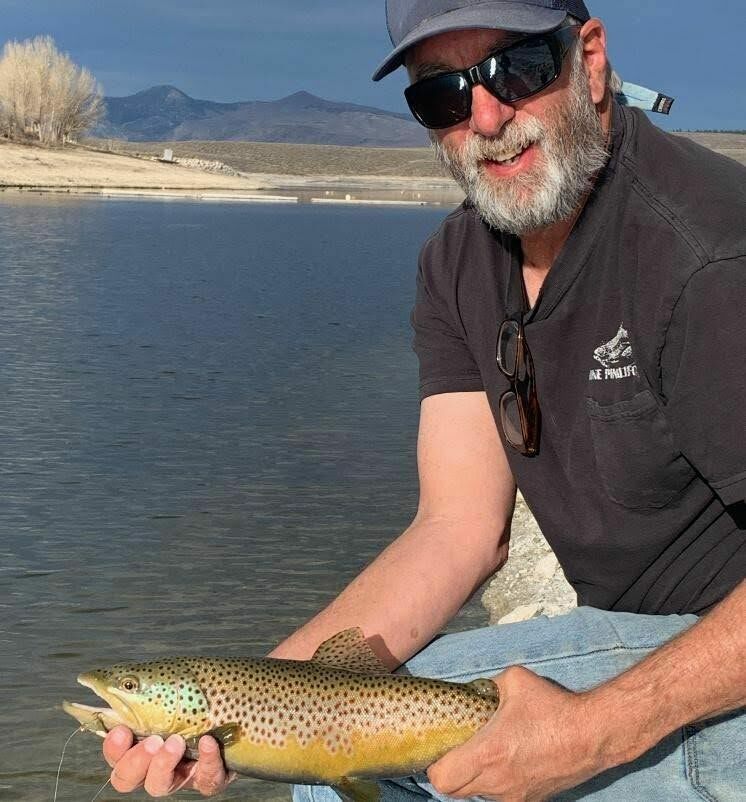 | Whether you’re new to fly fishing or an experienced angler, this presentation will offer valuable insight into exploring and fishing the Eastern Sierra. I remember being in the junior high school library and reading an article in one of the outdoor magazines about a gentleman who made his living as a full-time angler. This became my life-long goal.
I went to college at Humboldt State University, earning a degree in fishery biology. I spent a summer working on the Klamath River studying the habits of adult and juvenile salmon and steelhead. Full-time fisheries jobs were near impossible to find, and I had fallen in love with the Eastern Sierra, particularly the Mammoth Lakes area, after a summer teaching fly fishing and fly tying there. I moved to Mammoth in June of 1981, with my new wife, Cindy, taking a job with Safeway grocery store to pay the bills.
In 1982 I started Sierra Bright Dot the first fly fishing guide service in the Eastern Sierra. I built this into a summer seasonal fly-fishing shop, guide service, and fly-fishing instructional business. I lectured and wrote about the fly-fishing opportunities in the Eastern Sierra.
In May 2016, I retired from Vons grocery store in Bishop. After a year of enjoying the fly-fishing opportunities of the Eastern Sierra I’m back to teaching, guiding, writing and lecturing on fly fishing and fly tying. | Congratulations Larry Frede!
Fresno Fly Fishers for Conservation 2026 Founders Award Recipient | 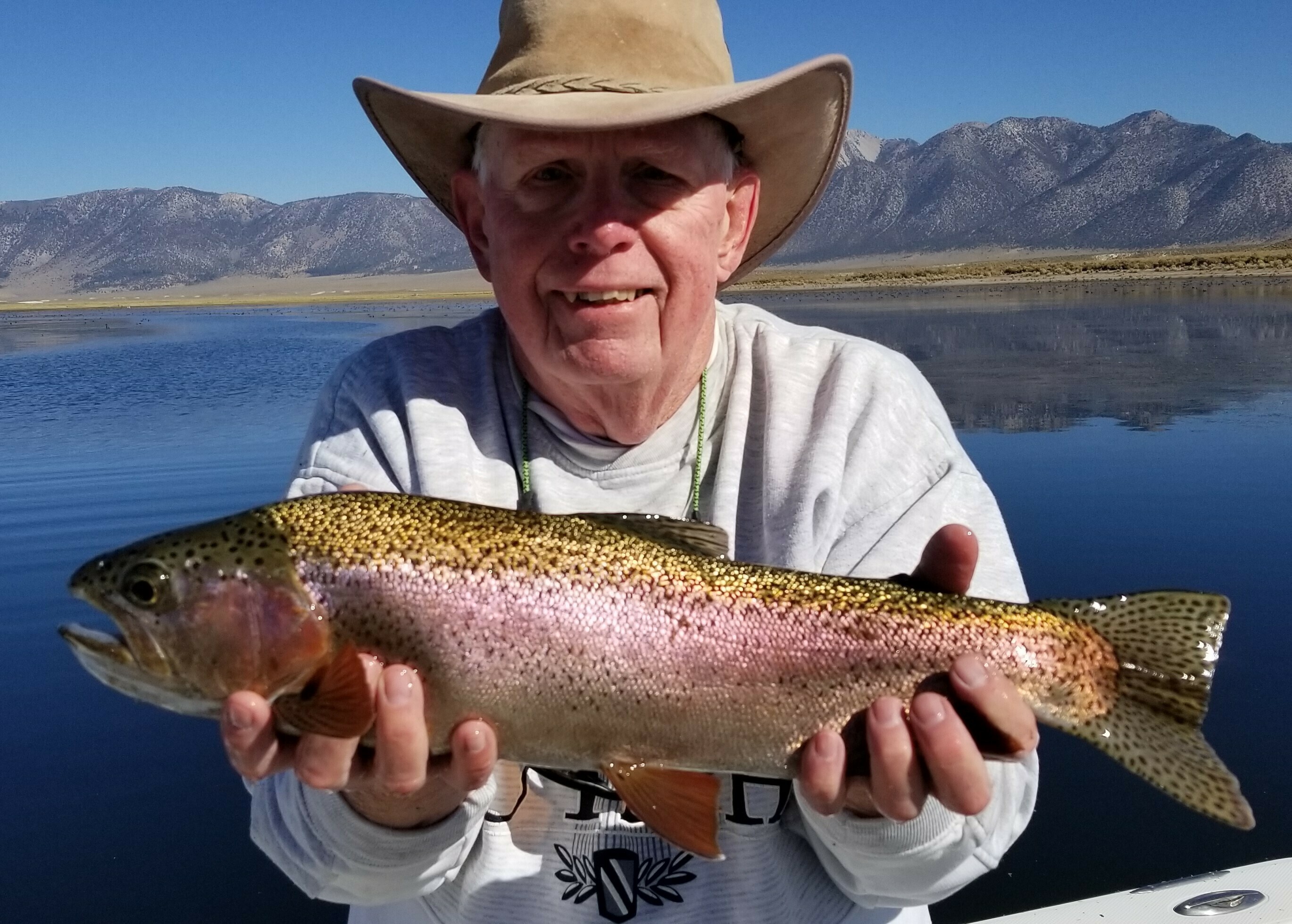 | | Larry has been a long time member of the club and is currently a board member. Larry can always be counted on to assist in the adult, women's and youth academies. While Larry is a highly regarded artisan rod builder and craftsman who has hosted rod building classes for the club over the last six years, he's even a better teacher of rod building. I can say, from personal experience, that Larry will patiently repeat himself and provide encouragement, as often as necessary, when the rod building is not going according to plan... When you walk away from a conversation with Larry, you will walk away with the feeling you have just had a conversation with a friend.
Larry has been married to Anita for 49 years - we thank Anita for sharing Larry with us and all of the volunteer work that he does on behalf of the club.
The Fresno Fly Fishers for Conservation board of directors is honored to recognize Larry as this year's Founders Award recipient. | A personal note from Larry...
On September 17th at the FFFC Fiesta Banquet I was awarded the Founders Award for the year 2026. I first joined the Club in 1978 and have been a member on and off until now. I am currently the rod building director. I am truly grateful for this honor.
Thank you to the Board of Directors, all members who have learned from my classes and a special thanks to Gavin O'Leary, who joined my class a few years ago and has built several beautiful fly rods. He now assists me with the classes.
Thanks to all.
Respectfully.
Larry Frede |  | |
General Club Meeting October 1
Provost & Pritchard Building
455 W. Fir Ave, Clovis
East Side - Crowley Lake and Owens River October 23-25
The East side is loaded with great fishing options. Crowley Lake, Owens River, Hot Creek, and other waters in the area give us the opportunity to experience stillwater, river and blue line streams while enjoying one of California's premier fly fishing destinations. This is a weekend trip you will not want to miss. We encourage you to stay at Tom's Place near Crowley Lake. This is a rustic lodge with great history and in a great location. Register HERE
General Club Meeting November 3
Provost & Pritchard Building
455 W. Fir Ave, Clovis
Oneill Forebay - Striper on the Fly November 7
We will spend the day at O'Neill Forebay targeting striped bass on fly tackle. Bring your heavier rods and streamers for a very different kind of fly fishing adventure.
Trinity River Float with Confluence Outfitters - November 11-14
The Trinity River is one of the most popular steelhead destinations in California. One reason for this status is that the Trinity rarely "blows out" due to high water. High flows from winter storms are absorbed by Trinity Lake, so even during large storms it's common for the uppermost floats to remain fishable. For the majority of the steelhead season, flows remain stable and conducive to wading and drift boat fishing. We are planning 3 nights in an Airbnb in Junction City. Two days of guided fishing the Trinity River by drift boat with Confluence Outfitters. THIS OUTING IS FULL
General Club Meeting December 5
Provost & Pritchard Building
455 W. Fir Ave, Clovis
Go Here to see our full Event Calendar and to register for events
| | Fishing Through Climate Change | Regardless of the mechanism, our climate is changing. Summer seems to start earlier and burn hotter every year. Hoot Owl closures have been implemented in rivers across the Western United States as water temperatures climb too high for us to fish without causing high fish mortality. As bad as it is, we can still find alternative ways to scratch our fishing itch. Warm water species such as bass, panfish and even carp still thrive when water temperatures are on the rise.
I wrote a column a few months back in which I extolled the virtues of urban fisheries. At the time I had written that piece I had yet to actually try any warm water fishing opportunities. I’m pleased to let you know that has changed. Starting this spring and into summer I have made multiple trips near my home in Colorado to fish for carp. Most of the time I come back sunburned and humbled by this wary adversary, but on a couple of occasions I caught fish! | | Carp have a lot of things going for them: they thrive under conditions that would kill most other fish, they are plentiful, they are challenging to catch, and they can take you into your backing with blistering runs. On the downside, unlike trout, they don’t often live in pretty places. I have had to work my way round a fair amount of urban waste to get to the fish (think tires, abandoned shopping carts and homeless encampments to name a few). The visual harshness aside, it is all worth it once you elicit a take from one of these strong fish. | | | Carp are highly evolved organisms. They lack good eyesight but all of their other senses are heightened. Carp are able to sense the slightest vibrations even those made outside of the water. I’ve been counseled to walk like a heron and not make any visible ripples in the water to avoid spooking these fish. If a carp is disturbed it emits a pheromone that alerts other nearby carp to flee. There are a lot of factors working against the angler and that is the challenge. After multiple unsuccessful carp forays, I broke down and hired a guide. Smart move.
I attended a free carp seminar at the Golden Fly Shop. There was a lot of good information I picked up but nothing beats hands on learning. I hired Triston Bewley (one of the presenters) to guide me on a carp trip. We started our day on a section of the Denver South Platte River. Access was easy as a hiking/biking trail runs along the river. Triston gave me multiple shots at carp but I didn’t connect. The goal is to cast your fly past the fish by several feet, quickly raise your rod to drag the fly along the surface, and then at precisely the right time drop your rod. If done correctly, the fly will flutter in front of and slightly to the side of the carp’s head. This is called the “drag and drop”. When things go as planned, the carp tuns on your fly and suctions it into his mouth. The angler seeing all of this then sets the hook and the game is on. The key is to find a receptive fish. The fish to target should have their head down and be actively feeding. Many of the fish we saw were cruising or not actively feeding. The chance of one of those fish taking a fly is very unlikely. After several unsuccessful hours on the river Triston had us move to a local reservoir.
When fishing in a river, the angler must factor in the water current when dropping the fly into the zone. Still water ponds and lakes take water current out of the equation, making it a little easier. When a carp feeds, it will often create plumes of mud as his mouth works the bottom looking for food. These mud plumes, along with the fish’s tail fanning the surface of the water in the shallows, are telltale signs of a “happy” carp (those most susceptible to a well-placed fly). | | The strategy here is to walk the bank scanning the water for these fish. That’s where a guide makes all the difference. Triston saw carp where I saw nothing. When the sun is high in the sky the ability to see through the water is improved. For the untrained eye it is still tough to see carp through murky water.
Towards the end of our day Triston pointed out a tailing fish 40’ from the bank. I wouldn’t be able to see the carp take my fly, but there was chance I could entice it to eat by stripping my fly with short and slow 3 inch strips. I cast in the direction the carp was moving and started stripping my line. It came tight and the fight was on. He came close to the net several times, but each time he would bolt out into the deeper water. After a few minutes, Triston was able to net my fish and I was able to relax enough for a quick photo. | | | | I encourage you to not turn your nose up at the lowly carp. These fish can bring excitement on a hot summer day when fishing for trout is out of the question. They are often quite close to home, too. I hope to bring in a carp expert to present at one of our upcoming meetings. Stay tuned. | Back of Beyond Stephen Neal
In Wildness is the Preservation of the World - “Henry David Thoreau." | | “Red sky at night, sailors’ delight. Red sky at morning, sailors take warning.” And “A ring around the moon means weather soon.” Two little weather proverbs my father passed on to me, earned from his Boy Scout training, and camping, fishing, and hunting experience along with two-plus years training for and fighting in the allied invasion of Fortress Europe. The wisdom he passed on was my first meal at the table of outdoor weather knowledge. It fed my thirst for more information as I navigated the wider world beyond our back door. Guess which proverbs I whisper when I see a red sky or the halo around an autumn moon. | | | Chopaka Lake, WA - May 2025 - Passing Nimbostratus
cloud formation illuminated by the rays of a setting sun.
The Red Sky that night was a delight. |
Clouds have always fascinated me. Inside or outside, my eyes seek the clouds, picking out patterns and pictures. Dragons, horses, birds, waterfalls, fish, trees, and other fanciful things feed my imagination and thirst for my nature immersion. Like John Muir I aspire to become one with nature.
As a child the big thunderstorms that lit up the sky over our Fresno/Clovis home kept my rapt attention and left me seeking more knowledge. The lightning, hail, downpours, and intense wind of those thunderstorms had me memorizing the names of the specific cloud formations that had created them. Climatologists called those highly moistured, charcoal bottomed, lighting throwing clouds Cumulonimbus.
I learned to recognize these cloud formations just as I also grew to recognize the names of specific trees, fish, and aquatic insects for the same reason, to become one with nature. All of this information might at one time be important for survival. Since thunderstorms can wreak havoc, learning to identify them as they are building brings one a step closer to safety.
Each cloud formation tells a story. Cirrus was the next cloud formation I learned. Not because it was big or flashy but because it was peaceful and it announced a weather change. These thin, wispy clouds are high, above 6,000 meters. When they appeared I knew that the current weather pattern was ending and a new one was approaching. | 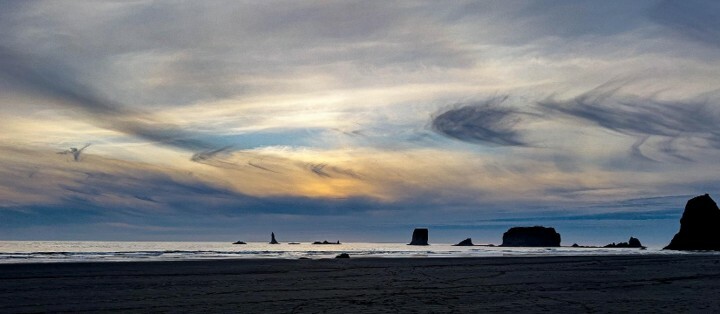 | | La Push, WA - March 2018, Cirrostratus Clouds formation – Middle of picture - left to right Cloud fisherman casting to a cloud Steelhead “There be Monsters out there.” | | Over time I picked up the names of other cloud patterns. Besides Cirrus, the other high-level cloud patterns include Cirrocumulus, and Cirrostratus. The former are small patches that predict fair weather, though possibly cold. The latter are thinly veiled and may presage rain or snow. Middle elevation clouds (2,000 to 6,000 meters) include Altocumulus, Altostratus, and Nimbostratus. Altocumulus are puffy patches of white which foretell fair weather, while the gray Altostratus predict steady precipitation. | | A middle to low level formation is Nimbostratus, dark and thick, warning of continuous rain and/or snow. Low level cloud formations (0 to 2,000 meters) include Stratus (flat, gray, and drizzly), Stratocumulus (lumpy, layered, and predicting possible weather change) and Cumulus, which are fluffy, bright, fair-weather clouds. This brings us back to my favorites, the Cumulonimbus. I loved watching these vertical giants with all their pent-up energy move across the Arizona desert during its summer monsoon season. They were breathtaking with their display of electrical energy and torrential downpours. Those desert thunderstorms marching across the canyonlands seemed to feed a primal need. | | | Detail of Casting fly-fishermen from above picture | Meteorological conditions touch our lives continuously. Farmers and ranchers endlessly discuss having too much or too little moisture. All serious fishermen are continuously aware of weather conditions, avoiding even mentioning “W” lest we jinx ourselves.
Weather conditions have had major effects on history. Wars at sea and land have been won and lost due to the fickle nature of weather. Inclement weather has shaped our history and will continue to do so. Following are some examples of weather’s impact on history.
The American Revolution almost ended in the summer of 1776. George Washington, expecting an attack on New York by the British, spread his inexperienced Continental Army across Manhattan, Brooklyn and Queens; not knowing where the British would attack. On August 27th the British launched a powerful assault, outnumbering and outmaneuvering the green American troops and pinning them against the East River. Under cover of darkness, Washington began ferrying the troops across the river, but with dawn approaching most of the army was still in Brooklyn and all seemed lost. But then an unexpected dark and dense fog rolled in, completely concealing the Continental Army. This providential weather phenomenon allowed the entire army to escape. | | In 1812 Napoleon invaded Russia with more than 600,000 troops; he expected a quick victory and soon captured Moscow. But then the Russian winter hit and temperatures fell to 40 degrees below zero. The soldiers had little winter clothing and food became scarce. Men and horses died from cold and exhaustion. The brutal winter turned the campaign into a catastrophe. The ferocious weather changed the course of history.
One might have expected mankind to have learned its lesson from Napoleon’s defeat by the brutal Russian weather. But no, as Hitler was to learn in WWII. Just like Napoleon, he invaded Russia, again expecting a quick victory. His army was routed in the severe winter of 1943-44. This led to his eventual defeat in 1945.
| | | | Rialto Beach, WA - storm clouds through "Hole in the Wall" | In April 1815, Mount Tambora in Indonesia erupted, blasting immense amounts of ash and sulfur high into the atmosphere. Powerful winds carried the particles across the globe, blocking the sun and causing temperatures to drop world-wide. That weather event resulted in 1816 to be known as “The Year Without Summer.” Across the Northern Hemisphere harvests failed, food prices surged, livestock died, and famine spread. Riots and looting soon followed. The monsoon season in China was disrupted, fueling a deadly cholera outbreak across Asia that eventually reached Europe.
In 1588 King Phillip II of Spain sent a massive naval fleet – the Spanish Armada – to invade England, overthrow Queen Elizabeth, and restore Spanish influence over England. The plan depended upon coordination, timing, and favorable winds. Instead, powerful Atlantic storms sent most of the Armada off course.
Multitudinous Spanish ships were blown upon the rocky shores of Ireland and Scotland, crushing Spanish dreams and leading to English dominance for centuries. Yet another example of weather’s impact on history.
Weather touches every minute particle of our lives, from barometric pressure triggering headaches to the particles we breathe and the oxygen we need to survive. Storms have spared us as well as taken lives. We ignore dire weather warnings at our own peril.
Take time to get to know our planet, for all life on this, our green gem, is tied together. Watch the clouds, sip cool water, and dip your fly in pristine water to touch the fish that rises to your fly. Read our history and then fight like hell to protect it. We only get one go-around on this planet, so let’s get it right. Keep your weather eye peeled.
Thank you, Mother Earth!
| |
A Big Thank You, to Tennis Terrance for his editing suggestions.
“The world is out there, the journey starts the minute you leave the door, go outside and truly live.” – S. Neal
“When given the choice between being right or being kind, choose kind – Dr. Wayne W. Dyer
“Many go fishing all their lives, without knowing that it is not fish they are after” - Henry David Thoreau
| | Rialto Beach looking east over the Quillayute River at passing early spring storm. |
Here are a few additional links to other information and websites you might find useful:
|  | ABOUT US
We are a Fly Fishers International affiliated club, a national organization whose goal, like ours, is to promote the wonderful sport of fly-fishing as well as protect our natural resources. We promote catch and release, education, conservation, and above all, encourage and help those who desire to learn more about all aspects of fly-fishing.
Fly Fishers for Conservation (FFFC) was organized in 1961 by a group of devoted fly fishers deeply concerned with the preservation of trout and all game fish, their environment, and the quality of fishing. Our club has maintained two goals since that time: To foster and promote the sport of angling with artificial flies. To protect, conserve and increase our angling resources.
Go Here if you would like to join our club!
Fly Fishers for Conservation is a 501(c)3 tax-exempt non-profit organization. This means you can use your contribution as a tax deduction. The club gets revenue from member-ship dues and the annual fundraiser dinner. We try to contribute to conservation issues in the area and to our youth with our Trout in the Classroom program, the No Child Left Inside program and by holding a Youth Fly-Fishing Academy annually. The club is al-ways in need of funds. Please consider donating. You may send a check to Fly Fishers for Conservation at PO Box 1192, Clovis, CA 93613. Your donations will be greatly appreciated and they will help the club fulfill its obligations.
|  | | Support received from the following.... | |